

How to Store Coffee Beans to Keep Them Fresh: Preserving Your Daily Ritual
Imagine opening a fresh bag of Ethiopia Natural, the aroma filling your kitchen like a vivid memory of a morning spent traveling. You brew a cup, expecting that same vibrant spark, but instead, you find a flat, dusty shadow of what the coffee used to be. It's a quiet disappointment that many of us face when we don't quite know how to store coffee beans to keep them fresh. High quality beans are an investment in your daily joy. Watching them go stale feels like losing a piece of the ritual that connects your morning to the wider world.
You likely already know that air and light are the enemies, but the conflicting advice about freezers or specialized canisters can make the process feel more complicated than it needs to be. We believe that preserving your coffee should be as intentional as the brewing itself. In this guide, you'll learn the essential techniques to protect your beans so every cup tastes as bright as the day it left the roaster. We'll look at the science behind the ideal 18 to 21 degree Celsius storage temperature and help you build a simple, repeatable routine. Since beans are at their peak between 4 and 15 days after roasting, your storage method is the only thing standing between a perfect cup and a wasted batch.
Key Takeaways
- Identify the four primary enemies of freshness and how they specifically target the volatile compounds in your favorite single-origin beans.
- Explore the differences between simple airtight containers and advanced vacuum technology to decide how to store coffee beans to keep them fresh on your own kitchen counter.
- Learn why your beans act like a sponge for kitchen smells and how to protect their natural aroma from being overshadowed by moisture or humidity.
- Shift your purchasing habits toward smaller, frequent quantities to ensure your coffee stays within its peak flavor window, rather than letting a bulk bag go stale.
- Integrate storage into your daily ritual, turning a technical necessity into a moment of care for the craft and the story behind every bean.
The Four Enemies of Freshness: Why Coffee Goes Stale
Coffee is at its most expressive just after the roast master finishes their work. However, the moment those beans leave the roaster, they begin a delicate dance with their environment. Understanding how to store coffee beans to keep them fresh starts with recognizing that coffee is a living, changing thing. It's hygroscopic, which is a fancy way of saying it acts like a sponge. Your beans eagerly soak up moisture and stray odors from your kitchen. If you leave them near a steaming stove or a pungent spice rack, they'll quickly lose their unique character.
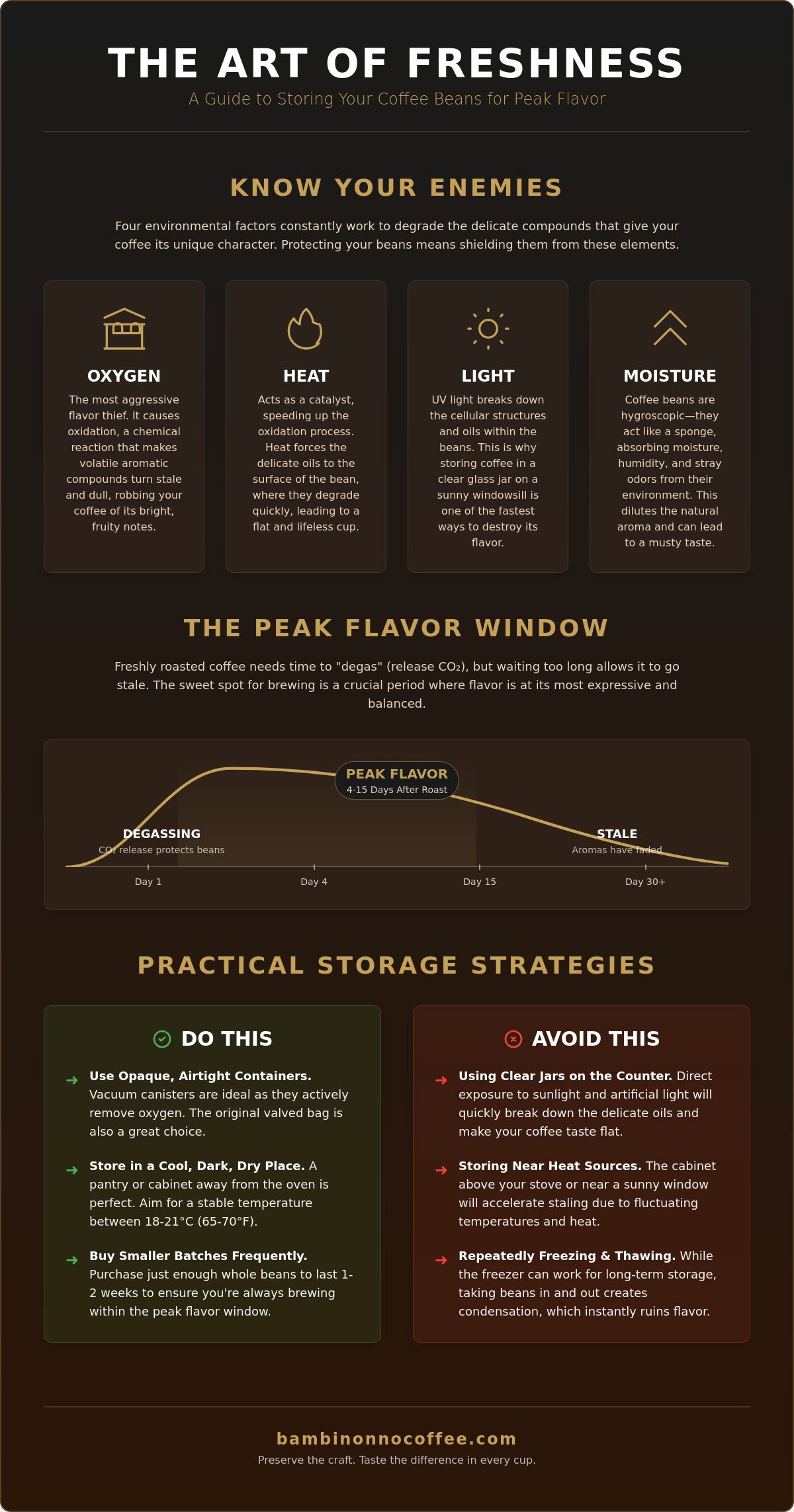
Oxygen is the most aggressive thief of flavor. It triggers oxidation, a chemical process that steals the volatile compounds responsible for those bright, fruity notes you love. Heat and light act as silent catalysts, accelerating the breakdown of delicate oils on the bean's surface. This is why a clear jar on a sunny windowsill is a recipe for a dull, flat cup. When these oils degrade, you lose the "bloom," that satisfying aromatic puff of gas that signals a fresh extraction during your morning pour over. For a deeper look into these chemical shifts, you can consult this comprehensive guide to coffee storage.
To better understand this concept, watch this helpful video:
Degassing: Why Your Beans Need to 'Breathe'
Carbon dioxide (CO2) is the bean's natural protector. In the first few days after roasting, this gas slowly escapes, creating a tiny pressurized shield that helps push oxygen away. Most specialty bags feature a one-way valve designed specifically for this. It lets the CO2 out so the bag doesn't burst, but it won't let the "enemies" inside.
Our story of exploration has shown us that patience is a key ingredient in the perfect cup. There's a specific "sweet spot" for brewing that usually falls between 4 and 14 days after the roast date. During this window, the degassing has slowed down enough to allow for a balanced extraction, yet the flavors remain at their peak. If you wait too long, the CO2 shield vanishes, leaving your beans vulnerable to the elements. Treating your coffee with this level of care ensures that every cup is a tribute to the craft behind it.
Practical Strategies for Storing Your Coffee Beans
Many people wonder if they need a shelf full of expensive gadgets to protect their beans. For your daily Breakfast Blend, the original packaging is often quite effective if it includes a one-way valve and a sturdy zip-lock. These bags are designed to let the beans breathe without inviting the elements inside. If you want to step up your game, vacuum canisters are an excellent choice. They use push-down technology to remove excess air from the headspace, which is a major step in how to store coffee beans to keep them fresh because it actively limits oxidation.
Finding the right spot in your kitchen is just as vital as the container you choose. Placing your Peru beans in the cabinet directly above the stove is a common mistake. The rising heat and steam from cooking will degrade the delicate oils faster than almost anything else. According to the National Coffee Association's storage tips, coffee thrives in a cool, dark, and dry environment. Aim for a steady room temperature between 18 and 21 degrees Celsius. Finding a dedicated corner away from the oven is a big part of how to store coffee beans to keep them fresh over the long haul.
The freezer remains a point of debate, but it can be useful for bulk purchases you don't plan to use for several weeks. If you choose this route, seal the beans in an airtight, moisture-proof bag. Never take the bag out just to scoop a daily portion. The rapid temperature change causes condensation to form on the beans, which ruins the flavor profile instantly. Only thaw the beans when you're ready to move them to your counter for good.
Roast Level and Storage Sensitivity
Different roasts have different needs. Dark roasts are more porous because their cell structure breaks down further during the roasting process. This makes them prone to rapid oxidation. Light roasts are denser and tend to hold their nuanced floral notes for a few days longer. If you enjoy flavored coffees, store them in their own dedicated containers. This prevents cross-contamination, ensuring the aroma of one batch doesn't wander into your other single-origin beans.
Whole Bean vs. Ground: The Surface Area Problem
The "15-minute rule" is a helpful guide for any enthusiast. Once you grind coffee, the surface area increases by a massive percentage, causing it to lose its aromatic potential almost instantly. We always encourage a grind-as-you-go philosophy. It's the simplest way to ensure those vibrant flavors end up in your cup rather than disappearing into the air. If you're curious about which storage setup fits your specific morning routine, feel free to reach out to us for a personal recommendation.
The Bambinonno Approach: Freshness as a Ritual
Coffee is more than a simple morning caffeine source. It's a bridge between the quiet, still moments of the early hours and the vibrant memories of the places we've traveled. At Bambinonno, we believe the secret to a truly great cup isn't just in the gear you own, but in the respect you show the bean. This is why we advocate for buying only what you'll enjoy within a week or two. When you purchase in small batches, you ensure your coffee stays within that 4 to 15 day peak flavor window. It turns the act of restocking into a recurring celebration of fresh discovery.
Our Story of Exploration was built on years of travel and the understanding that the best things in life require a bit of care. The "first opening" of a new bag should be a mindful experience. Take a second to appreciate the aroma before moving the beans into your storage setup. While finding the perfect spot in your kitchen involves some experimentation, following the National Coffee Association guide to storing coffee provides a solid foundation for your daily routine. Learning how to store coffee beans to keep them fresh is ultimately about protecting the unique story each bean has to tell.
When to Say Goodbye: Identifying Stale Beans
Sometimes, despite your best efforts, a bag lingers a bit too long. You can usually identify this through a simple "sniff test." Fresh beans carry a complex, punchy aroma, while stale ones often smell dull, papery, or even slightly like old cardboard. You should also check for visual cues. Freshly roasted coffee often has a healthy sheen from its natural oils. If the beans appear completely matte and dusty, they've likely lost their vitality and most of their aromatic potential.
Don't just toss these beans in the bin. While they might not be ideal for a delicate pour over, they still work well for a long-steeped cold brew or as a nitrogen-rich addition to your garden compost. Every bean has a purpose, even when its peak has passed. Let your palate be the final judge. If a cup doesn't spark joy, try a new storage spot or a different container for your next batch. The journey to a perfect brew is one of constant, curious discovery.
Elevate Your Morning Ritual
Your journey with coffee shouldn't end at the checkout. By keeping your beans in a cool, dark place and avoiding the humid heat of the stove, you protect the delicate extraction potential you've worked so hard to achieve. Remember that buying in small batches is the most effective way to ensure you're always brewing within that peak freshness window. Mastering how to store coffee beans to keep them fresh is the final, essential step in honoring the journey of the bean from high-altitude forests to your kitchen.
At Bambinonno, we take this craft personally. We source responsibly from high-altitude regions and roast every batch in small quantities right here in the USA. To make it easier for you to keep your pantry stocked with the freshest options, we provide free shipping on all coffee orders. If you're still refining your pantry layout or have a specific question about your home setup, ask our roasting team directly! We're always here to share our passion and help you find that perfect, vibrant cup. Trust your palate, keep exploring, and enjoy every mindful sip of your daily ritual.
Frequently Asked Questions
Can I store my coffee beans in the refrigerator?
You should not store your coffee beans in the refrigerator. The internal environment of a fridge is filled with moisture and various food odors that coffee beans will eagerly absorb. Every time you open the door, the temperature fluctuates, causing condensation to form on the beans and destroying their delicate oils. To understand how to store coffee beans to keep them fresh, you must keep them away from the damp, cold air of a refrigerator.
How long do coffee beans stay fresh in an airtight container?
Whole coffee beans stay fresh for approximately 2 to 4 weeks when kept in a quality airtight container at room temperature. While the beans are still safe to brew after a month, the vibrant flavor notes typically found in single-origin roasts will begin to fade. It is a proven fact that pre-ground coffee loses its freshness 10 times faster than whole beans, so keeping your coffee in its whole form until the moment of extraction is vital for flavor preservation.
Should I keep my coffee in the original bag or move it to a jar?
The original bag is often sufficient if it has a one-way valve, but moving your beans to an opaque, airtight canister is usually the better long-term choice. Opaque containers protect the beans from UV light, which acts as a catalyst for staling. If you choose to use a jar, make sure it is stored inside a dark cupboard where the temperature stays between 18 and 21 degrees Celsius. This steady environment prevents the oils from breaking down prematurely.
Does freezing coffee beans actually ruin the flavor?
Freezing doesn't ruin the flavor if you only use it for long-term storage of unopened bags. The danger comes from taking a bag in and out of the freezer, which creates immediate condensation on the bean surface and ruins the cup quality. If you are learning how to store coffee beans to keep them fresh during a bulk purchase, seal them in airtight portions and thaw them completely to room temperature before opening the seal. Never refreeze beans once they have been thawed.