

How to Store Coffee Beans to Keep Them Fresh: Preserving Your Daily Ritual
A recent April 2026 report revealed that 85% of coffee lovers now brew their daily cup at home, the highest percentage recorded since 2012. You've likely felt that quiet joy of opening a fresh bag of Ethiopia Natural, only to notice the vibrant notes of berry start to fade into a dull flatness just a few days later. It's a common heartbreak for anyone who values the craft and the journey behind every bean. Learning how to store coffee beans to keep them fresh is the only way to ensure your morning ritual remains as soulful as that first sip. You shouldn't have to guess whether the freezer is a friend or a foe or settle for cluttered counters filled with ineffective jars.
I want to help you protect your investment and the dedication of the master roaster who perfected your beans. You'll learn the simple, repeatable habits that shield your coffee from its four main enemies: oxygen, light, heat, and moisture. We'll explore the science of bean aging and review tools that actually work, such as the $67.95 Fellow Atmos vacuum canister. By the end, you'll have a clear routine that keeps your home-brewed coffee tasting professional, vibrant, and full of life.
Key Takeaways
- Identify the four silent enemies-oxygen, moisture, heat, and light-that strip away the vibrant, volatile compounds in your favorite roast.
- Discover how to store coffee beans to keep them fresh using vacuum technology that removes air from the headspace of your container.
- Learn why the hygroscopic nature of coffee makes it a magnet for kitchen smells and why the refrigerator should be avoided at all costs.
- Adopt a mindful approach to freshness by purchasing smaller batches that align with your weekly brewing ritual and sense of exploration.
- Understand when the original bag is sufficient and when it is time to upgrade to a dedicated storage solution to preserve those delicate tasting notes.
The Four Enemies of Freshness: Why Coffee Goes Stale
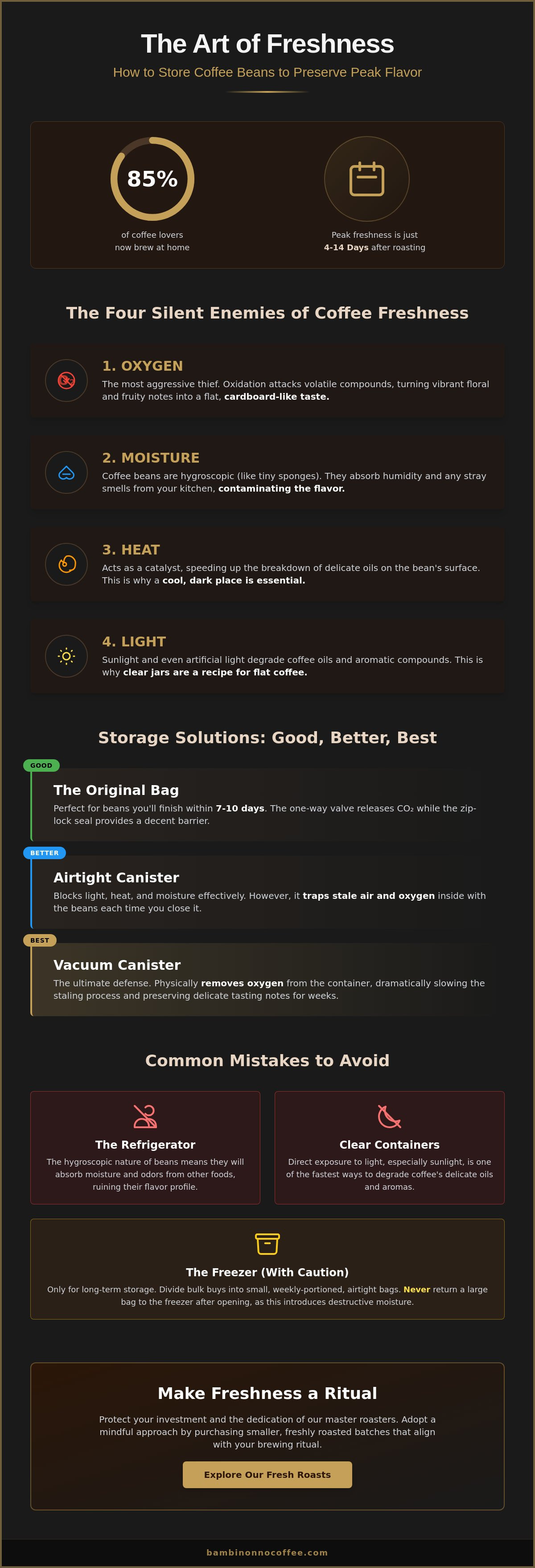
Every bean tells a story, but that story begins to fade the moment it leaves the roaster. Understanding storing coffee beans is about more than just kitchen organization; it's about preserving the hard work of the farmers and the dedication found in our Story of Exploration. Oxygen is the most aggressive thief. It attacks the volatile compounds that give your coffee its distinct floral or fruity aroma. This chemical process, called oxidation, turns a vibrant cup into something that tastes like dusty cardboard.
To see how these elements impact your coffee and whether extreme measures like freezing are worth your time, watch this deep dive from James Hoffmann:
Moisture is equally dangerous because coffee beans are hygroscopic. They act like tiny sponges, soaking up humidity and any stray smells from your kitchen. If you leave your beans near a spice rack or a stove, they'll eventually taste like whatever you cooked for dinner last night. Light and heat act as catalysts, speeding up the breakdown of the oils on the bean's surface. This is why clear jars on a sunny windowsill are a recipe for flat coffee. When you brew, you'll notice the absence of the bloom, that beautiful rise of gas that signals the coffee is still alive and full of flavor.
Degassing: Why Your Beans Need to 'Breathe'
Freshly roasted coffee isn't ready for the cup immediately. For the first few days, beans are packed with Carbon Dioxide (CO2), which actually acts as a temporary shield against oxygen. This is why our bags feature a one-way valve. It lets the CO2 escape without letting the four enemies inside. Most specialty beans hit their sweet spot between 4 and 14 days after roasting. If you're curious about how to store coffee beans to keep them fresh, remember that patience is part of the ritual. Giving the beans time to degas ensures a balanced extraction and a cleaner taste in your morning pour-over.
Practical Strategies for Storing Your Coffee Beans
Choosing the right vessel for your coffee is like choosing the right frame for a cherished family photo; it protects the heart of the story within. If you're enjoying our Breakfast Blend as part of your daily morning ritual, the original bag is often your best ally. Modern specialty bags are designed with a one-way valve and a sturdy zip-lock seal. This setup works beautifully for beans you plan to finish within 7 to 10 days. However, once that initial seal is broken, your strategy needs to evolve.
For those who prefer to rotate through different origins, vacuum canisters offer a superior defense. Unlike standard airtight jars that trap stale air inside with the beans, vacuum canisters use 'push-down' technology to physically evacuate oxygen from the headspace. This is a vital technique in how to store coffee beans to keep them fresh because it limits the chemical interactions that lead to staleness. Location is equally important. Storing your Peru beans in the cabinet above the stove exposes them to fluctuating temperatures and steam. The National Coffee Association's guide to coffee storage confirms that a cool, dark, and dry spot is the only way to maintain flavor integrity.
The freezer can be a useful tool for bulk purchases, provided you avoid the trap of condensation. Never take a large bag out of the freezer, scoop some beans, and put it back. This introduces moisture that ruins the batch. Instead, divide your bulk buy into small, airtight portions that hold only enough for one week. If you're unsure which method fits your lifestyle, feel free to reach out to us for a personal recommendation.
Roast Level and Storage Sensitivity
Different roasts require different levels of care. Darker roasts are more porous and have more surface oils, making them oxidize much faster than lighter options. A light roast is denser and can hold its complex, acidic profile for a few extra days. If you enjoy flavored coffees, keep them in a dedicated container to prevent their strong aromas from migrating to your single-origin beans.
Whole Bean vs. Ground: The Surface Area Problem
Ground coffee is highly volatile. Because grinding increases the surface area exposed to the air by thousands of times, the '15-minute rule' applies: most of the aromatic potential vanishes shortly after the beans are broken. We always encourage the 'grind-as-you-go' philosophy. It is the simplest way to ensure every cup features the full spectrum of flavors the pörkölőmester intended.
The Bambi Nonno Coffee Approach: Freshness as a Ritual
At Bambi Nonno Coffee, we believe a truly great cup is about the connection it fosters and the quiet moments it creates. While mastering how to store coffee beans to keep them fresh is a vital skill, we often advocate for 'buying for the moment.' Instead of stocking up for months, try purchasing small batches that last you about 10 to 14 days. This ensures that the delicate profiles of your beans never have the chance to fade into the background. Our Story of Exploration was built on these fleeting moments of discovery during our travels, where we learned that coffee is best enjoyed when it's at its peak.
Make the unboxing of a new bag a mindful part of your day. That first release of aroma when you break the seal is a reward in itself. We encourage you to lead with curiosity and experiment with your environment. Try keeping your beans in a cool pantry for one week and a dedicated ceramic jar the next. Let your palate be the final judge of which spot preserves that vibrant bloom and clean extraction you've come to love. Your kitchen has its own unique rhythm, and finding the perfect corner for your coffee is part of the joy.
When to Say Goodbye: Identifying Stale Beans
Even with the best care, beans eventually reach the end of their peak journey. Use the 'Sniff Test' to check for a dull, papery scent or a complete absence of those rich, chocolatey notes. Fresh beans often have a healthy sheen from their natural oils, while stale beans appear matte and lifeless. If you find a bag that's past its prime, don't just throw it away. Beans that have lost their brewing spark are still wonderful for a slow-steeped cold brew, a homemade coffee scrub, or even as a nitrogen-rich addition to your garden compost. The next time you reach for a bag, take a second to truly smell the beans before grinding; it's the best way to stay connected to the life of your coffee.
Elevate Your Morning Ritual
Your morning cup is more than just caffeine; it's a bridge between generations and a reminder of the quiet beauty in everyday habits. By mastering how to store coffee beans to keep them fresh, you honor the journey the bean took from high-altitude forests to your kitchen. Remember to shield your coffee from oxygen and light, use vacuum canisters for long-term preservation, and always lean toward smaller, frequent purchases that match your weekly rhythm.
We take our part in this ritual seriously. Every bag we send is small-batch roasted in the USA, ensuring you receive the peak expression of our responsibly sourced beans. To help you maintain this standard at home, we provide free shipping on all coffee orders. This makes it easy to buy exactly what you need for the days ahead without letting a single bean go stale on the shelf.
If you're still fine-tuning your storage spot or want to know more about a specific origin, we're here to help. Have a specific question about your home setup? Ask our roasting team directly! Every great cup starts with a little curiosity and a lot of care. Happy brewing.
Common Questions About Coffee Freshness
Can I store my coffee beans in the refrigerator?
You should avoid the refrigerator entirely when deciding where to place your beans. The fridge is a humid environment filled with competing aromas, and because coffee is naturally hygroscopic, it will act like a sponge and soak up the scent of your leftovers. Every time you open the door, the temperature shift causes condensation to form on the beans, which damages the delicate oils and ruins your extraction.
How long do coffee beans stay fresh in an airtight container?
Coffee beans generally maintain their character for 2 to 4 weeks in a standard airtight container. While the beans remain safe to brew after this point, the vibrant, nuanced notes of a roast start to fade significantly after day 14. To enjoy the most soulful experience, try to finish your beans within this two-week window to capture the peak of their aromatic potential.
Should I keep my coffee in the original bag or move it to a jar?
The original bag is an excellent short-term home if it features a one-way valve and a strong zip-lock seal. These bags are designed to protect the beans during the first 7 to 10 days of use. If you plan to savor the bag over a longer period, moving your beans to an opaque vacuum canister is a more effective strategy for how to store coffee beans to keep them fresh.
Does freezing coffee beans actually ruin the flavor?
Freezing doesn't ruin the flavor if you follow a strict deep-freeze method and protect the beans from moisture. According to a 2026 industry consensus, you can preserve beans for several months by freezing them in small, vacuum-sealed portions. The danger only arises when you take a bag out, open it, and put it back. This creates immediate condensation that destroys the cell structure of the bean and kills the flavor.