

Matcha Green Tea Benefits: What the Evidence Really Says
What if the appeal of matcha is less about a miracle health claim and more about what’s in the cup? The matcha green tea benefits people talk about are often linked to caffeine and L-theanine, along with catechins such as EGCG. Because matcha is consumed as a powder, you drink the whole leaf rather than only the compounds that steep into water.
It’s understandable to want a clear answer when claims range from better focus to broad promises about health. Research suggests caffeine may support alertness, and scientists are studying L-theanine in relation to attention and calm focus. But many other claims draw on studies of green tea extracts or individual compounds, not matcha as a drink.
Here, we’ll look at matcha’s key compounds, what research can and can’t tell us, and practical ways to enjoy a cup thoughtfully. The goal is to keep health claims in perspective and make room for a ritual you enjoy.
Key Takeaways
- Matcha’s powdered form means you consume the leaf, unlike steeped tea, where you remove the leaves before drinking.
- Matcha green tea benefits are still being studied. Some findings are specific to matcha, while others concern green tea more broadly or concentrated extracts.
- Research can suggest possibilities, but it does not make matcha a treatment or guarantee a health outcome.
- Choose a preparation you enjoy and pay attention to your own caffeine tolerance instead of chasing a perfect cup.
What Matcha Green Tea Contains and Why Those Compounds Matter
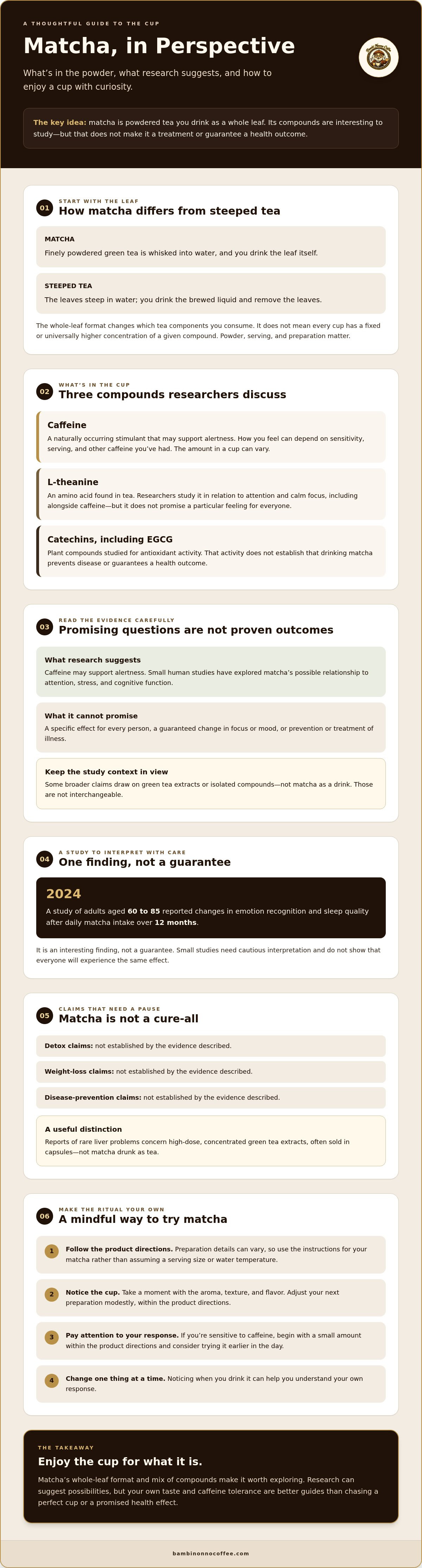
Matcha is powdered green tea that you whisk into water and drink, rather than steeping leaves and removing them. For a concise overview of its name and traditional production, see Matcha. The whole-leaf format helps explain what you consume, but it does not make every wellness claim about matcha a proven health effect.
Like other green teas, matcha contains catechins, a group of plant compounds. One catechin is EGCG, short for epigallocatechin gallate. Catechins are studied for their antioxidant activity, but that does not show that drinking matcha prevents disease or guarantees a particular health outcome. Matcha also contains caffeine, a naturally occurring stimulant. The amount in a cup can vary, so the word “matcha” alone cannot tell you exactly how much caffeine you are drinking.
How Matcha's Whole-Leaf Format Shapes Its Composition
With steeped tea, you drink the brewed liquid and discard the leaves. With matcha, the finely powdered tea is whisked into the drink, so you consume the leaf itself. That changes which tea components you take in, but it does not mean every cup has a fixed or universally higher concentration of a given compound. The powder, serving, and preparation all matter.
L-theanine, an amino acid found in tea, is another compound of interest in matcha research. Its presence is one reason researchers study matcha’s combination of compounds. It is not proof that a cup will reliably change your mood or focus. Keep that distinction in mind when considering matcha green tea benefits: the drink’s composition can be interesting without making it a cure or a guaranteed wellness tool.
If you’re curious to try matcha, consider the taste and experience as well as the research. You can explore the tea collection and see how matcha fits into your routine.
Matcha Green Tea Benefits: What Research Suggests and What It Cannot Prove
Some research on matcha is promising, but not all research about green tea applies directly to matcha. Catechins such as EGCG have antioxidant activity, yet that does not establish that drinking matcha prevents illness or produces a specific health outcome. Some broader claims come from studies of green tea extracts or isolated compounds, which are not the same as drinking matcha.
Small human studies have explored matcha’s possible effects on attention, stress, and cognitive function, including in older adults. A 2024 study of adults aged 60 to 85 reported changes in emotion recognition and sleep quality after daily matcha intake over 12 months. That is an interesting finding, not a guarantee. Small studies need cautious interpretation and do not show that everyone will experience the same effect.
Promising research can suggest possibilities, but it cannot guarantee a health outcome from drinking matcha.
Can Matcha Support Focus or Energy, and What About Caffeine?
Caffeine can promote alertness, but how you feel depends on factors such as your sensitivity, serving, and other caffeine you’ve had. L-theanine is also being studied, including alongside caffeine, but research findings do not promise a particular feeling of calm focus for every person. Notice your own response rather than treating matcha as a guaranteed energy or concentration aid.
Claims that matcha detoxes the body, causes weight loss, or prevents disease are not established by the evidence described here. Reports of rare liver problems concern high-dose, concentrated green tea extracts, often sold in capsules, not matcha drunk as tea. The difference matters.
If you’re curious to explore matcha as a drink, browse the tea collection. Enjoy the cup for what it is, rather than expecting it to deliver a health benefit.
How to Enjoy Matcha Mindfully as Part of Your Tea Ritual
Start by following the preparation directions provided with your matcha. Measure and whisk the powder as directed, then take a moment to notice the aroma, texture, and flavor. Since preparation details can vary by product, follow the instructions for the matcha you have rather than assuming a particular serving size or water temperature.
Let your palate guide any changes. If the flavor feels too strong, adjust your next cup within the product directions. If it tastes light, make a modest change and see what you prefer. There is no single perfect method to chase. The aim is to find a preparation you enjoy.
A Simple Starting Point for Trying Matcha
Make your first cup when you have a moment to pay attention, and notice how you feel afterward. Matcha contains caffeine, so if you’re sensitive to it, begin with a small amount within the product’s directions and consider trying it earlier in the day. Change one thing at a time, such as when you drink it, so you can better understand your personal response.
Exploring the tea collection can be one way to make room for a daily pause. If coffee is part of your routine too, bring the same curiosity to how you brew it.
For a simple ritual, prepare your cup before opening your inbox, then take a few unhurried sips and note what you enjoy. If you’d like to know more about Bambi Nonno’s Matcha, ask through the store’s contact options. Let curiosity, not promises about matcha green tea benefits, shape your next cup.
Make Your Next Cup a Small Experiment
The most useful way to think about matcha green tea benefits is to keep curiosity and evidence together. Matcha contains compounds researchers are studying, but findings about green tea extracts or small matcha studies do not guarantee the same effects for everyone. Caffeine may support alertness, while your own response depends on your sensitivity and the cup you prepare.
Start with the product directions, then notice the flavor and how the timing feels for you. A cup can be worth enjoying for its taste and ritual, without asking it to deliver a health promise.
Bambi Nonno Coffee offers Matcha alongside a range of teas. If you have a question about the Matcha offering, get in touch with us. Explore the tea collection and try a thoughtful cup, letting your own experience guide the next.
Frequently Asked Questions
What are the potential benefits of drinking matcha green tea?
Matcha provides caffeine and tea compounds such as catechins, including EGCG, which are studied for their antioxidant activity. Some small human studies have explored matcha’s possible effects on attention, stress, and cognitive function, but the evidence is limited. These findings do not establish that matcha prevents disease or guarantees a particular health benefit.
Does matcha have more caffeine than regular green tea?
Matcha can contain more caffeine per serving than brewed green tea, but the amount varies with the powder used and serving preparation. One reported comparison estimated about 72 mg of caffeine in 2 grams of matcha, versus 28 to 38 mg in a cup of sencha. Those figures are examples, not a fixed amount for every cup.
Can matcha help with focus or energy?
Caffeine may increase alertness, so matcha could feel energizing, but your response depends on your sensitivity and how much caffeine you’ve already had. Researchers are also studying L-theanine alongside caffeine, but that does not mean matcha will reliably improve focus or create a particular feeling. Notice how you respond rather than relying on a promised effect.
Is matcha safe to drink every day?
Daily matcha may suit some people, but there isn’t one answer that fits everyone. Consider your total caffeine intake and whether matcha affects your sleep or makes you feel uncomfortable. Rare liver problems have been linked to high-dose green tea extracts, often in capsules, not matcha consumed as tea. Extracts and a cup of matcha are different.