

How to Make Espresso at Home Without a Machine: The Manual Brew Guide
The most soulful cup of coffee doesn't require a thousand dollar machine or a counter full of bulky steel. While 83% of us are now brewing our daily ritual at home, many feel trapped between expensive equipment and the chemical aftertaste of instant packets. You might think a true, concentrated shot is impossible without high-pressure pumps, but learning how to make espresso at home without a machine is actually about returning to the heart of the craft. It's about the quiet patience of a manual brew that honors the beans' journey from the soil to your favorite mug.
I'll show you how to craft a rich, concentrated espresso-style base using simple tools like a $19.99 Bodum French Press or a classic $39.95 AeroPress. We'll demystify the confusion around grind sizes and water temperatures so you can stop guessing and start tasting. You'll gain the confidence to master the bloom and extraction techniques that turn your kitchen into a personal sanctuary. We are going to explore three reliable manual methods and the specific steps to ensure your home-brewed shots are bold enough for a perfect latte or a smooth, straight sip.
Key Takeaways
- Learn how to make espresso at home without a machine by using immersion and steam to create a brew with the same heavy body and intense flavor you love.
- Explore why the steam-driven Moka Pot and the modern AeroPress offer the most authentic paths to a concentrated, manual shot.
- Master the 30-second bloom technique to degas your coffee grounds, paving the way for a more even and flavorful extraction.
- Keep your water temperature steady at 200°F to safeguard the delicate notes of your small-batch beans from being scorched.
- Transform your daily ritual by turning simple kitchen tools into a reliable way to craft premium coffee bases for any milk-based drink.
The Essence of Espresso: Why You Don't Need a Machine for a Bold Shot
Many coffee lovers feel that without a massive, chrome-plated appliance taking up their counter space, they're destined for watery and uninspiring cups. That isn't the case. When we look at What is Espresso?, we are really discussing a specific concentration of flavor and a heavy, lingering body. While a standard machine uses exactly 9 bars of pressure to force water through grounds, you can achieve a remarkably similar intensity through steam or immersion. Learning how to make espresso at home without a machine is a choice to prioritize the ritual over the hardware. It's a way to slow down and truly connect with the origin of your drink.
The soul of a great shot doesn't live in a circuit board. It lives in the heat of the water, the precision of your grind, and the story behind the beans. By using manual tools, you gain total control over every variable. This hands-on approach turns a simple caffeine fix into a moment of discovery. It reminds me of the quiet, intentional coffee habits I've observed in small kitchens while traveling across different continents.
To better understand how these manual methods compare to the traditional pump-driven process, watch this helpful video:
Why the Right Roast is Your Secret Weapon
If you want that rich, chocolatey finish, your choice of bean is your most important ally. Medium-to-dark roasts are generally superior for manual brewing because they extract more easily. This provides the deep body required for a concentrated shot. Using freshly roasted coffee beans is non-negotiable. Fresh beans still hold the CO2 necessary to create a beautiful, thick approximation of crema. Our Guatemala single-origin provides a cocoa-toned base that holds its own beautifully even when mixed with steamed milk.
Three Best Methods for Making Espresso-Style Coffee Without a Machine
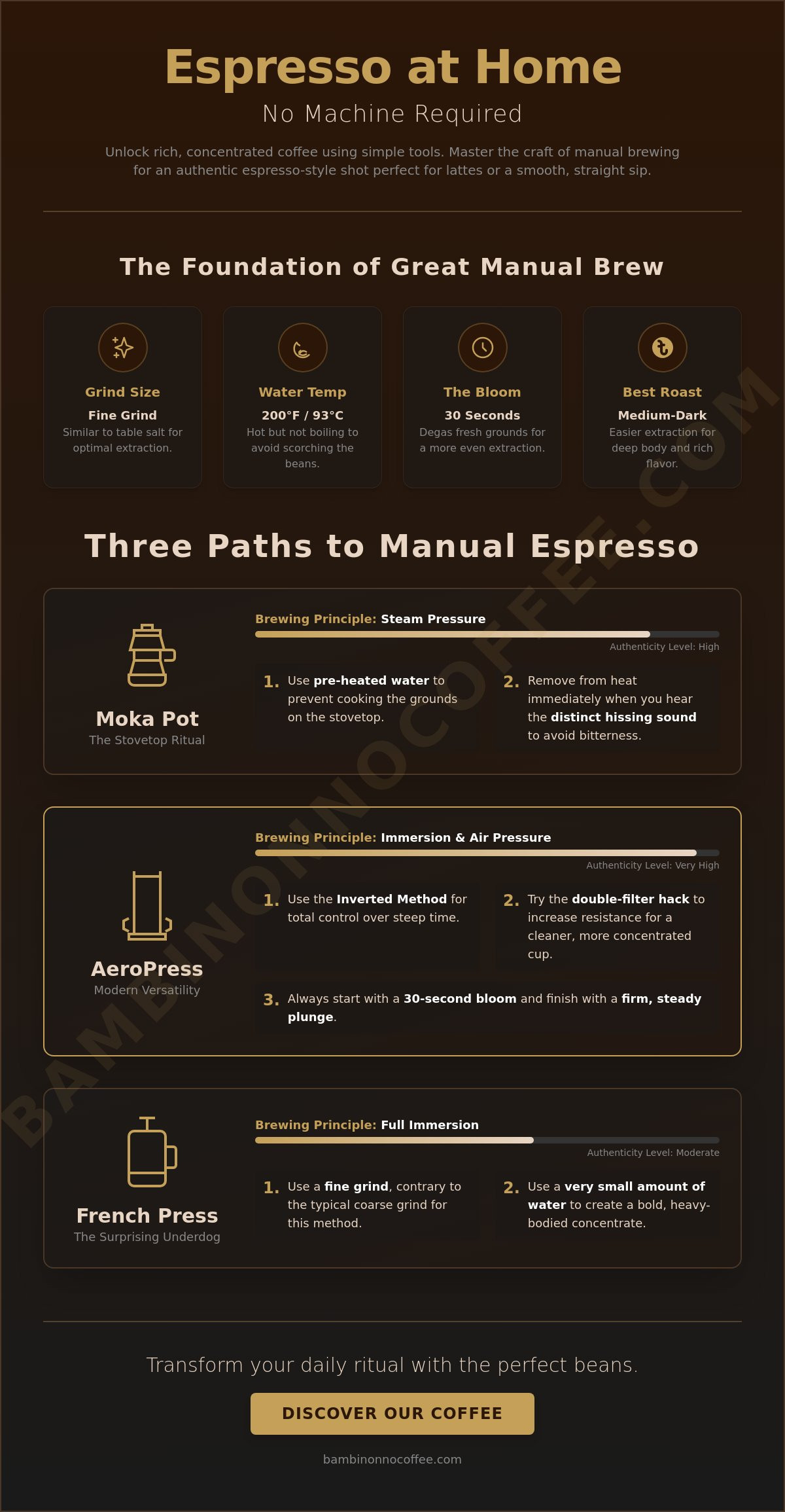
Finding the right tool for your morning ritual is a personal journey that relies more on technique than expensive hardware. When you are exploring how to make espresso at home without a machine, three specific tools stand out for their ability to create that intense, velvety base we all crave. Regardless of the method you choose, success starts with your grind. You'll want a fine texture, similar to table salt. This ensures the water meets enough resistance to extract those deep, complex notes without the brew becoming thin or sour.
The Moka Pot: A Timeless Stovetop Ritual
The Moka Pot is perhaps the closest relative to a traditional machine because it uses steam pressure to push water through the coffee. To get the best results, I always recommend filling the base with pre-heated water. This prevents the metal from cooking your grounds before the brewing even begins, which often leads to a bitter taste. Watch the pot closely. The moment you hear that distinct hissing sound, remove it from the heat immediately. This simple step preserves the delicate oils and prevents over-extraction. For us, the rich aroma that fills the kitchen during this process is a core part of our story and our shared love for the craft.
The AeroPress: Modern Versatility for the Manual Shot
The AeroPress is a favorite for those who love to experiment with their brew. While the standard method works, the Inverted Method gives you far more control over the steep time. Start with a 30-second bloom to let the grounds degas; this small pause makes a world of difference in the final extraction. To really elevate the pressure and mimic a machine shot, try the double-filter hack. By using two paper filters, you create more resistance, resulting in a cleaner and more concentrated cup. When you're ready, apply firm, steady pressure during the plunge. If you ever feel stuck or want to share your results, feel free to reach out and say hello.
The French Press: The Surprising Underdog
Don't overlook the French Press sitting in your cupboard. While usually reserved for larger carafes of morning coffee, it can produce a heavy-bodied concentrate if you use a fine grind and a very small amount of water. It's a simple, immersion-based way to create a bold foundation for any latte without needing a single electric pump. This method highlights the body of the bean, providing a textured mouthfeel that holds up beautifully against steamed milk.
Perfecting the Pour: The Ritual of Small-Batch Brewing
Precision is the companion of patience. When you're mastering how to make espresso at home without a machine, the temperature of your water is your first checkpoint. Aim for exactly 200°F (93°C). Water that's too hot will scorch the delicate oils in your small batch roasted coffee beans, leaving you with a bitter, burnt aftertaste that masks the bean's true character. If you don't have a thermometer, let your kettle sit for about 60 seconds after it reaches a boil to hit that sweet spot.
Next, respect the bloom. This 30-second pre-wetting of the grounds is a vital pause in your morning. It allows the coffee to degas, releasing trapped carbon dioxide so that the water can penetrate the heart of the bean during the rest of the pour. Without this step, your extraction will be uneven, and you'll miss out on the complex sweetness that makes a manual shot so rewarding. It's a small detail that separates a generic cup from a memorable experience.
Consistency is the final technical hurdle you'll need to clear. Using a burr grinder is essential because it ensures every particle of coffee is the same size. If your grounds are uneven, some will over-extract while others remain untouched, creating a "muddy" flavor profile that lacks clarity. Once you have a consistent grind, don't be afraid to experiment. Adjusting your coffee-to-water ratio is the only way to find your personal goldilocks shot. Every bean has a story to tell, and small tweaks to your recipe help that story unfold.
The Ritual: Elevating Your Morning with Intent
Coffee is more than a caffeine delivery system. It is a moment of stillness, a quiet anchor before the world starts demanding your attention. Whether you serve your manual shot in a simple demitasse or use it as the robust heart of a homemade latte, the experience is yours to define. The best cup of coffee isn't defined by the price of the equipment on your counter. It's the one that connects you to the history of the craft and the simple joy of discovery. Tomorrow morning, take an extra minute to watch the bloom and breathe in the aroma. The reward is worth the wait.
Embrace Your New Morning Ritual
Mastering the art of how to make espresso at home without a machine is more than a cost-saving measure; it is a return to the quiet, intentional heart of coffee. You have seen how the right water temperature and a dedicated 30-second bloom can transform a simple grind into a concentrated masterpiece. Whether you choose the reliable pressure of a Moka Pot or the modern versatility of the AeroPress, the true quality of your cup starts with the bean. Our small-batch roasted coffee is crafted for peak freshness, ensuring every extraction carries the vibrant story of its origin.
We take pride in our responsible sourcing from high-altitude forests, bringing you a depth of flavor that honors the tradition of the craft. To make your journey even easier, we offer free shipping on all US coffee orders. It is time to step away from the bulky machines and find the soul of your shot in the ritual itself. Experience the bold tradition of our Italian Roast—perfect for your Moka pot.
The best cup of coffee is the one shared with a friend or enjoyed in a moment of solitary peace. Keep experimenting, keep tasting, and let every pour be a discovery.
Frequently Asked Questions
Can I get real crema without an espresso machine?
You won't get "true" crema because that requires exactly 9 bars of pressure; however, you can achieve a beautiful, thick foam approximation. This happens when you use freshly roasted beans that still hold their CO2. While it's not the chemically identical emulsion found in a cafe, it provides that same creamy mouthfeel. Aim for beans roasted within the last 14 days to maximize this effect in your manual brew and ensure a rich texture.
What is the best coffee-to-water ratio for manual espresso?
A 1:2 or 1:3 ratio is the ideal starting point for a concentrated, manual shot. For example, if you use 20 grams of coffee, aim for 40 to 60 grams of water. This is a significant departure from the 1:16 ratio used in standard drip coffee. Experimenting with these tighter ratios is key when learning how to make espresso at home without a machine to ensure the body remains heavy and the flavor stays intense.
Is a Moka pot the same as an espresso machine?
A Moka pot is not the same as an espresso machine because it only generates about 1.5 bars of steam pressure. In contrast, a traditional machine uses a mechanical pump to reach 9 bars. However, the Moka pot is the most effective way to produce a robust, concentrated brew at home. It captures the soul of a bold shot without the need for high-voltage equipment, making it a favorite for those who value the ritual over the machine.
Can I use regular drip coffee grounds for manual espresso?
You should avoid using pre-ground drip coffee because the particles are too coarse for a concentrated extraction. Drip coffee is ground for a 5-minute brew time, but manual espresso-style shots require a fine grind similar to table salt. If you use coarse grounds, the water will pass through too quickly. This results in a weak, sour cup that lacks the 10% to 15% TDS (Total Dissolved Solids) typically found in high-quality manual concentrates.