

How to Store Coffee Beans to Keep Them Fresh: Preserving Your Daily Ritual
You've just returned from a journey with a vibrant bag of Ethiopia Natural , memories of high-altitude hills still fresh in your mind. You grind the beans for your morning ritual, expecting that signature floral bloom, but the aroma is faint and the extraction tastes uncharacteristically flat. It's a quiet heartbreak to invest in premium beans only to watch their unique story fade before you can finish the bag. We've all felt that confusion while staring at a cluttered counter, wondering if the freezer is a secret ally or a recipe for stale coffee.
Understanding how to store coffee beans to keep them fresh is about more than just tidying up; it's about managing the bean’s natural transition from active to stable. Based on the latest research from the Specialty Coffee Association’s April 18, 2026, Handbook on Coffee Freshness, you'll learn how to protect your ritual from the four scientific enemies of flavor. We're moving beyond guesswork to provide you with a simple, repeatable routine that preserves the soul of your coffee. We'll explore the science of quantifying freshness so that every cup tastes as vibrant and intentional as the day it was roasted.
Key Takeaways
- Identify the "four enemies" that degrade volatile compounds, ensuring you never lose those delicate floral notes to oxidation or light.
- Learn exactly how to store coffee beans to keep them fresh by choosing the right container, from original one-way valve bags to specialized vacuum canisters.
- Discover why coffee’s "hygroscopic" nature makes it a sponge for kitchen odors and how to shield your beans from unwanted scents.
- Adopt a mindful, small-batch purchasing strategy that ensures your coffee is always enjoyed within its peak flavor window.
- Build a repeatable storage ritual that honors the bean’s journey and guarantees a vibrant extraction every single morning.
Table of Contents
The Four Enemies of Freshness: Why Coffee Goes Stale
Think of your coffee beans as a living memory of a distant landscape. When you open a bag of coffee, you’re engaging with years of care from farmers and pörkölőmesters alike. But the moment those beans meet the air, a quiet countdown begins. Understanding how to store coffee beans to keep them fresh starts with recognizing that they are fragile. As documented in the April 18, 2026, SCA Handbook on Coffee Freshness, the aging process is a measurable chemical shift that alters the bean's very soul. These principles are part of the wider history of coffee bean storage, where the goal has always been to pause time just long enough for the perfect cup.
To visualize how these elements impact your daily brew, watch this practical guide:
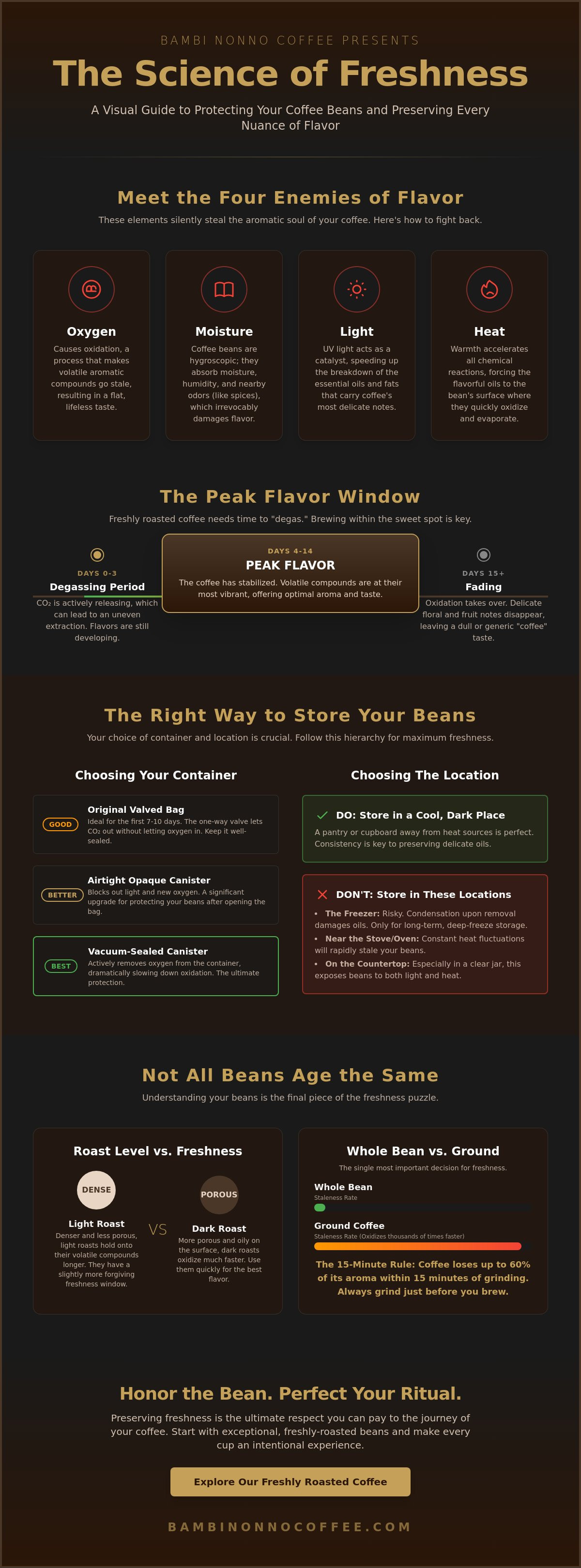
Coffee's flavor is under constant attack from four specific environmental factors. Oxygen is the most aggressive thief; it steals the volatile aromatic compounds that give your coffee its floral or citrus personality. Moisture is equally dangerous because beans are "hygroscopic." They act like a sponge, eagerly soaking up humidity and any nearby kitchen smells. Light and heat serve as silent catalysts, speeding up the breakdown of delicate oils on the bean's surface. If your beans are stale, they won't "bloom" during your pour-over. That satisfying puff is the release of gases. Without it, your extraction will lack the depth you deserve.
Degassing: Why Your Beans Need to 'Breathe'
Freshly roasted coffee is full of Carbon Dioxide (CO2). For the first few days, this gas actually protects the bean by pushing oxygen away. This is why most bags have a one-way valve. It lets the CO2 escape so the bag doesn't burst, but it prevents the enemies from entering. Mastering how to store coffee beans to keep them fresh means respecting this degassing period. Our story of exploration has taught us that coffee usually hits its "sweet spot" between 4 and 14 days after roasting. During this window, the flavors have stabilized, but the vibrancy of the origin is still at its peak.
Practical Strategies for Storing Your Coffee Beans
Choosing the right vessel for your beans is the first step in honoring your daily ritual. If you're brewing our Breakfast Blend every morning, the original packaging is often sufficient for the first few days. These bags feature one-way valves that allow gases to escape while preventing oxygen from entering. However, once you break that seal, you need a more permanent solution. Following National Coffee Association guidelines, the best way to maintain quality is to move your beans to an opaque, airtight container. Vacuum canisters with "push-down" technology are particularly effective because they physically remove the air from the headspace, which is a vital part of how to store coffee beans to keep them fresh for longer periods.
Location matters just as much as the container. A common mistake is placing your coffee in the cabinet above the stove or near a window. These areas are heat and moisture traps that will quickly dull the bright, nuanced acidity of a single-origin like our Peru. The freezer remains a debated topic, but it can work for bulk storage if handled with care. You must use a deep-freeze setting and ensure the beans stay in a completely sealed, moisture-proof bag. Never open the bag until it has fully reached room temperature. If you don't wait, condensation will form on the cold beans, damaging the delicate oils and leading to a muddy extraction.
Roast Level and Storage Sensitivity
Not all beans age at the same rate, and understanding this gap is key to better coffee. Darker roasts, like an Italian Roast, are significantly more porous. The roasting process has expanded the bean's cell structure, making it more susceptible to rapid oxidation. Light roasts are denser and hold onto their aromatic potential slightly longer. If you're unsure which storage method fits your favorite profile, reach out to us for a personal recommendation.
Whole Bean vs. Ground: The Surface Area Problem
The "15-minute rule" is a stark reality in the specialty world. Once you grind your coffee, the surface area increases exponentially, allowing aromatics to evaporate almost instantly. This is why we always advocate for a "grind-as-you-go" philosophy. Keeping your coffee in whole bean form is the ultimate freshness hack, ensuring that every cup captures the full story of the bean’s journey from the farm to your home.
The Bambinonno Approach: Freshness as a Ritual
At Bambinonno, we believe every cup is a bridge between the quiet of your morning and the vast world beyond. Our Story of Exploration was built on years of travel; it's a journey that taught us to respect the fleeting nature of a perfect roast. Storing your coffee isn't just a chore. It's a mindful act of preservation. We advocate for buying only what you need for the next 7 to 14 days. By choosing small-batch purchases, you ensure the beans in your hopper are always at their peak aromatic potential, reflecting the care put in by the pörkölőmester.
That first moment you unseal a new bag should be a celebration. Take a second to inhale the bloom of fragrance before you move the beans to their permanent home. While technical gear matters, learning how to store coffee beans to keep them fresh also involves a bit of curiosity. Try different cool, dark spots in your pantry. Let your palate be the final judge of what works in your specific kitchen environment. Following National Coffee Association guidelines provides a solid foundation, but your own sensory experience is what truly defines your ritual.
When to Say Goodbye: Identifying Stale Beans
Even with the best care, time eventually wins. You can identify beans that have passed their prime through a simple sniff test. Fresh coffee is vibrant and complex; stale coffee often carries a dull, papery, or even musty scent. Visually, look at the surface of the beans. If they appear matte and lifeless when they should have a healthy, slight sheen, they've likely lost their essential oils. If you find a bag that's stayed in the back of the cupboard too long, don't just throw it away. These beans are perfect for a long-steeped cold brew, a revitalizing coffee scrub, or as a nitrogen-rich addition to your garden compost.
Next time you open a fresh bag, try brewing one cup immediately and then another after a week of careful storage. Notice the subtle shifts in the extraction. This small experiment won't just improve your coffee; it'll deepen your connection to the craft itself.
Mastering the Art of Freshness
Your morning cup is more than just a routine; it's a vital connection to the high-altitude forests where each bean was responsibly sourced. By mastering how to store coffee beans to keep them fresh, you're protecting the dedicated work of the roaster and the integrity of your own daily experience. Keep the four enemies of flavor at bay by using airtight, opaque containers and prioritizing small-batch purchases that last no more than 14 days. We share this commitment to quality, which is why every bag we offer is small-batch roasted in the USA and delivered with free shipping on all coffee orders.
Preserving flavor is a personal journey of discovery rather than a set of rigid, corporate rules. Whether you're dialing in a vibrant single-origin or enjoying a comforting blend, the care you show your beans today defines the clarity of your extraction tomorrow. Have a specific question about your home setup? Ask our roasting team directly! We're always here to share our passion and help you find the perfect harmony in your kitchen. Keep experimenting with your storage spots and trust your palate as you continue your coffee journey.
Frequently Asked Questions
Can I store my coffee beans in the refrigerator?
No, you shouldn't store your beans in the refrigerator. Coffee is hygroscopic, which means it absorbs moisture and kitchen scents like a sponge. In a 2026 study by the Zurich University of Applied Science, researchers found that the fluctuating humidity inside a fridge leads to condensation every time you open the door. This moisture quickly degrades the delicate oils and introduces unwanted food smells into your morning ritual.
How long do coffee beans stay fresh in an airtight container?
Coffee beans typically stay at their peak for 14 to 28 days when kept in a quality airtight container. While the beans are still safe to use after this window, the vibrant acidity and floral aromatics start to fade significantly. Learning how to store coffee beans to keep them fresh means understanding that even the best vacuum seal can't stop time; it only slows the natural oxidation process.
Should I keep my coffee in the original bag or move it to a jar?
You should move your beans to an opaque, airtight jar if the original bag doesn't have a reliable, heavy-duty zip-lock seal. Many specialty bags include a one-way valve to let CO2 out, but they aren't always effective at keeping oxygen out once the heat seal is broken. A dedicated canister with a plunger mechanism can remove up to 90% of the air in the headspace, offering superior protection.
Does freezing coffee beans actually ruin the flavor?
Freezing doesn't ruin the flavor if you use a deep-freeze setting and keep the beans in a completely vacuum-sealed environment. This method works for long-term storage of bulk buys, but you must let the beans reach room temperature before opening the seal. If you open the bag while it's still cold, moisture will instantly condense on the beans, leading to a flat and muddy extraction during your next brew.