

How to Store Coffee Beans to Keep Them Fresh: Preserving Your Daily Ritual
What if the "shelf life" printed on your bag is actually a countdown to flavor mediocrity? With 66% of American adults drinking coffee daily according to the NCA Spring 2026 report, more of us are brewing at home than ever before. It's heartbreaking to watch a premium single-origin bean lose its soul before the bag is even half empty. You've likely felt that sting of disappointment when a vibrant roast turns into a flat, dusty cup just a week after opening. Learning how to store coffee beans to keep them fresh is the most important step you can take to honor the ritual of your daily cup and the quiet moments that connect us.
We both know that a cluttered counter and conflicting advice about the freezer only make your morning routine feel like a chore. This guide will teach you the essential techniques to protect your beans from flavor-destroying elements so every cup tastes as vibrant as the day it was roasted. We'll explore why vacuum canisters like the $29.99 Fellow Atmos are worth the space and how to manage the bean's natural transition from active to stable. You'll gain a simple, repeatable routine that ensures your home-brewed coffee remains a genuine moment of discovery and a legacy of quality in every sip.
Key Takeaways
- Identify the four environmental enemies—air, moisture, heat, and light—that strip away the delicate floral and fruity notes of your roast.
- Master the essential techniques for how to store coffee beans to keep them fresh by choosing between specialized vacuum canisters and high-quality one-way valve bags.
- Learn why roasted beans act like sponges and how to prevent them from absorbing unwanted kitchen odors that compromise their unique flavor profile.
- Adopt the ritual of buying small-batch beans for a 1-2 week window to ensure every cup honors the roaster's intent and craftsmanship.
- Understand the science behind 'push-down' technology and how removing excess headspace air can significantly extend the life of your favorite blends.
The Four Enemies of Freshness: Why Coffee Goes Stale
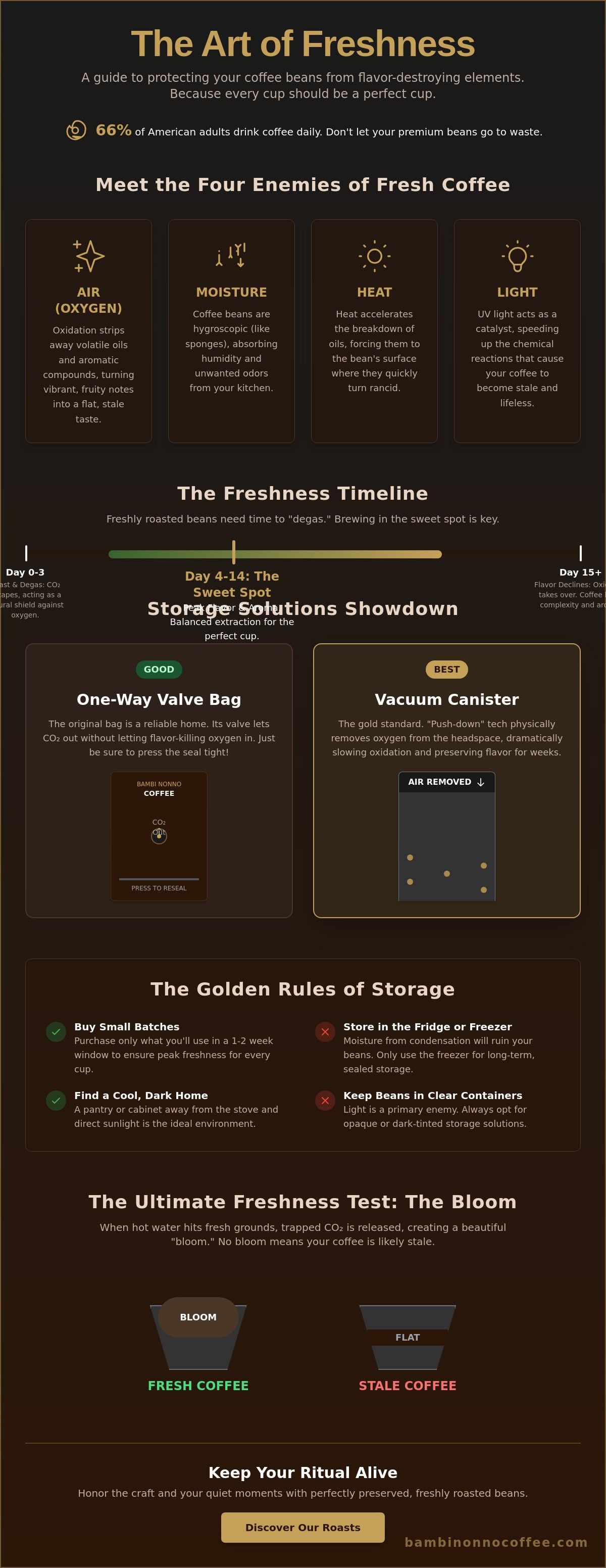
Oxygen is the primary thief of flavor. Once a bean is roasted, it begins a slow process of oxidation that strips away the volatile compounds responsible for those bright, fruity notes you love in a Guatemala single-origin. Properly storing coffee beans means creating a barrier against this chemical breakdown. When oxygen hits the bean's surface, it reacts with the delicate oils, turning a vibrant roast into something flat and uninspiring. It's a quiet tragedy that happens right on your kitchen counter if you aren't careful.
Moisture and light act as silent catalysts in this decline. Coffee beans are hygroscopic, which is a fancy way of saying they act like sponges. They don't just soak up humidity; they absorb the smells of your spice rack or last night's dinner. Heat and UV light also speed up the breakdown of the oils that carry the bean's unique story. Understanding how to store coffee beans to keep them fresh is mostly about finding a cool, dark, and dry home for your daily ritual.
To see these principles in action and learn how to set up your own storage station, watch this helpful video:
You can tell your beans have lost the battle when you don't see a "bloom" during your morning pour-over. That beautiful, gassy puff that happens when hot water first hits the grounds is the release of carbon dioxide. If your coffee sits flat and lifeless in the dripper, the gas has already escaped, taking the aroma with it. A lack of bloom is the clearest sign that your extraction will be dull and lacking the complexity that defines a truly great cup.
Degassing: Why Your Beans Need to 'Breathe'
Freshly roasted beans are packed with carbon dioxide (CO2). For the first few days after roasting, this gas actually acts as a natural shield, pushing oxygen away from the bean's surface. This is why you see one-way valves on high-quality bags. They let the CO2 escape so the bag doesn't burst, but they don't let the "enemies" in. Most enthusiasts find the "sweet spot" for brewing is between 4 and 14 days after the roast date. During this window, the gas has settled enough to allow for a balanced extraction without the metallic tang of excess CO2. It's a delicate balance that we've learned to respect through our story of exploration and obsession with the craft.
Practical Strategies for Storing Your Coffee Beans
Your choice of container is the first line of defense in your daily ritual. If you're brewing our Breakfast Blend every morning, the original bag is often a reliable home for those beans. High-quality bags feature one-way valves that allow carbon dioxide to escape while preventing oxygen from entering. Just ensure the zip-lock is pressed tight after every scoop to maintain that delicate barrier.
For those who want to master how to store coffee beans to keep them fresh over several weeks, vacuum canisters are the gold standard. Unlike standard airtight jars that trap air inside with the beans, vacuum canisters use "push-down" technology to physically remove oxygen from the headspace. This simple mechanical action can significantly slow down the oxidation process we discussed earlier. According to the National Coffee Association, the goal is to create an environment that is cool, dark, and dry.
Location is just as vital as the container itself. Many people instinctively reach for the cabinet above the stove, but this is the worst place for your Peru beans. The heat and steam from cooking create a volatile environment that forces oils to the bean's surface, where they quickly turn rancid. Stick to a dark pantry or a shaded spot on your counter away from direct sunlight.
The freezer debate often divides enthusiasts, but it can be a useful tool for bulk buys. If you must use the freezer, divide your beans into small, airtight portions and only take out what you need for a few days. Frequent temperature swings cause condensation to form inside the bag, which ruins the bean's structure. If you have questions about which storage method fits your favorite roast, feel free to reach out to us directly.
Roast Level and Storage Sensitivity
Darker roasts, like our Italian Roast, are more porous because they've spent more time in the roaster. This structural change makes them oxidize much faster than light roasts. Light roasts have a denser cellular structure that keeps flavors locked in slightly longer, but they still require care. If you enjoy flavored coffees, store them in a dedicated canister to prevent cross-contamination with your grinders and other beans.
Whole Bean vs. Ground: The Surface Area Problem
Freshness is a race against surface area. We advocate for the "grind-as-you-go" philosophy because of the 15-minute rule. Ground coffee exposes thousands of tiny surfaces to the air, causing it to lose most of its aromatic potential almost instantly. Keeping your coffee in whole bean form until the moment of brewing is the ultimate hack for a better-tasting cup. It turns a simple drink into a vibrant experience that honors the journey of the bean.
The Bambinonno Approach: Freshness as a Ritual
Opening a new bag of coffee should feel like a small ceremony. When you prioritize how to store coffee beans to keep them fresh, you aren't just following a technical manual; you're preserving a story that began in a high-altitude field and ends in your favorite mug. We advocate for buying for the moment. This means choosing small-batch bags that will last you exactly 1 to 2 weeks. It’s a habit that ensures your daily cup never tastes like a memory of what it used to be.
Our Story of Exploration was built on years of travel, where we learned that the best coffee is always a reflection of its immediate environment. We encourage you to treat your kitchen like a laboratory. Try different storage spots and let your palate be the final judge. The National Coffee Association notes that managing shelf life is a constant battle against the elements, but finding that perfect, cool corner for your beans makes the effort worth it every morning.
There is a unique joy in the 'first opening' of a fresh roast. Take a second to breathe in the aromatics before you transfer the beans to their container. This mindful pause turns a routine chore into a genuine connection with the craft. By keeping your supply lean and your storage disciplined, you ensure that every extraction is as vivid and complex as the pörkölőmester intended.
When to Say Goodbye: Identifying Stale Beans
Even with the best intentions, sometimes life gets in the way. You can identify beans that are past their prime with a simple sniff test. Fresh beans should jump out at you with distinct notes; stale beans often smell dull, flat, or even slightly like old paper. Visually, look for a matte, dusty appearance on beans that should have a healthy, slight sheen. If your beans have lost their spark, don't just throw them away. They work beautifully for a batch of cold brew, can be repurposed into an exfoliating coffee scrub, or added to your garden compost to nourish the soil. Your next bag is a fresh chance to start the ritual again.
The next time you reach for a scoop, ask yourself if the aroma still takes you somewhere new. If not, it might be time to refresh your storage routine.
Honoring the Craft in Every Cup
Your coffee's journey doesn't end when the bag arrives at your doorstep. It's a living story that requires your care to stay vibrant and expressive. By defending your beans against the four enemies of freshness and choosing a cool, dark pantry over a sunny counter, you honor the dedication of farmers working in high-altitude forests. Mastering how to store coffee beans to keep them fresh is the final, essential step in a craft we've spent years exploring across the globe.
Every selection we offer is small-batch roasted in the USA to ensure you receive the most aromatic beans possible. Because we believe quality should be accessible, we provide free shipping on all coffee orders. This makes it easier for you to buy exactly what you need for a two-week window without overstocking. If you have a specific question about your home setup or need advice on protecting a unique single-origin, Ask our roasting team directly! We're always here to help you protect the quiet, daily ritual that brings us together. Keep exploring, keep brewing, and let every sip be a discovery.
Frequently Asked Questions
Can I store my coffee beans in the refrigerator?
You should avoid the refrigerator entirely because it's a breeding ground for moisture and unwanted smells. Coffee beans act like sponges; they'll absorb the scent of yesterday's leftovers within 24 hours. The constant temperature fluctuations every time you open the fridge door cause condensation to form on the bean's surface. This moisture ruins the delicate oils and kills the bloom before you even start your morning ritual.
How long do coffee beans stay fresh in an airtight container?
Most whole beans stay at their peak for 14 to 30 days when kept in a quality airtight container. While the beans won't expire in the traditional sense, the vibrant acidity and floral notes begin to fade after the first two weeks. Using a vacuum canister is a great way for how to store coffee beans to keep them fresh for the full month because it removes the air that causes oxidation.
Should I keep my coffee in the original bag or move it to a jar?
You can keep your coffee in the original bag if it has a one-way valve and a sturdy zip-lock seal. These bags are specifically designed to let CO2 escape while blocking oxygen. If you prefer a jar, ensure it's opaque or kept in a dark pantry. Clear glass jars expose your beans to UV light, which can degrade the flavor profile 15% faster than dark storage according to common industry observations.
Does freezing coffee beans actually ruin the flavor?
Freezing doesn't inherently ruin flavor, but improper handling certainly will. If you're freezing a bulk buy, use small, vacuum-sealed portions to prevent air and moisture from entering. Never take a bag out of the freezer, scoop some beans, and put it back. This creates ice crystals that damage the bean's structure. For the best results, let the beans reach room temperature before you break the seal to protect the extraction quality.