

Light Roast vs. Dark Roast Coffee: Finding Your Perfect Morning Ritual
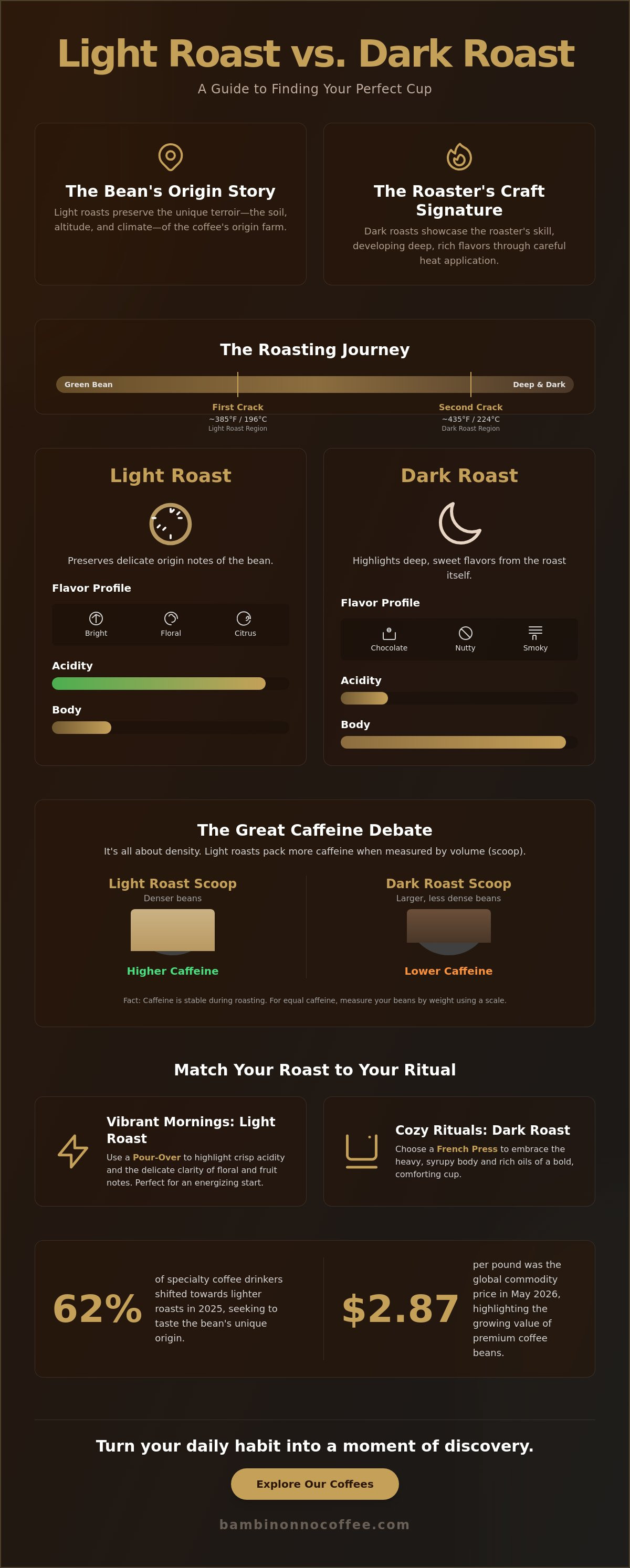
The choice between light roast vs dark roast coffee isn't about quality. It's a choice between the bean's "origin story" and the roaster's "craft signature." In 2025, 62% of specialty coffee drinkers moved toward lighter profiles, showing a growing desire to taste the unique altitude and varietal of the bean rather than the heat of the roast. This shift reflects a deeper connection to the craft, even as global commodity prices reached $2.87 per pound in May 2026.
It's frustrating to invest in premium beans only to find the flavor profile doesn't match your quiet morning ritual or your French press. You've likely heard the common myth that darker beans offer more caffeine, a misunderstanding that often leads to buying the wrong bag for your needs. We want you to feel confident when reading labels, understanding exactly how the roasting process affects acidity, body, and your final extraction.
You'll discover the science behind the new SCA-130 color standards and how to match specific roasts to your brewing style. We'll help you find the beans that turn your daily habit into a genuine moment of discovery and warmth, ensuring every cup tastes like the passion that went into growing it.
Key Takeaways
- Understand how the "first crack" marks the moment we decide to preserve a bean's delicate floral notes or lean into deep, roasted sugars.
- Navigate the light roast vs dark roast coffee choice by identifying whether your palate craves bright, citrusy acidity or the bold, smoky comfort of molasses.
- Clear up the confusion surrounding caffeine content and bean density so you can dial in the perfect energy level for your morning.
- Learn why your brewing gear matters, from using pour-overs for clarity in lighter beans to choosing a French press for the heavy mouthfeel of a dark roast.
- Pick your roast based on the mood of your day, matching vibrant profiles to busy mornings and comforting, bold blends to slow weekend rituals.
The Roasting Journey: From Green Bean to Your Cup
Every morning ritual starts long before you reach for your grinder. It begins in the roaster, where heat acts as a catalyst to unlock the chemical potential hidden inside a green, dense seed. Understanding the nuances of light roast vs dark roast coffee helps you curate a morning that feels intentional. The coffee roasting process is a transformative dance of chemistry; it's where hundreds of aromatic compounds are born through the Maillard reaction. We define a roast profile as the balance between time and temperature, a signature that dictates whether you'll taste the farm's soil or the roaster's flame.
The difference between these styles comes down to timing. When beans reach roughly 385°F, they expand and pop, a stage we call "first crack." Stopping here preserves the bean’s delicate cellular structure. If we keep going, the beans reach "second crack" around 435°F. At this point, the internal oils migrate to the surface, and the sugars fully caramelize into something deep and bittersweet. It's a journey from raw potential to a cup that tells a story.
Light Roast: Preserving the Terroir
Think of light roasts as the storytellers of the coffee world. Because they spend less time in the heat, they highlight the "terroir," which is the specific combination of soil, altitude, and climate from the farm. You'll experience bright acidity, floral aromas, and a tea-like body that's incredibly crisp. Whether it's a washed or natural process, light roasting respects the work of the farmers, especially in vibrant Guatemala profiles where citrus and stone fruit notes take center stage. They're perfect for those moments when you want to explore the world through your mug.
Dark Roast: The Roaster's Signature
As the roast deepens, the bean's original acidity fades, replaced by the roaster’s craft. This is where you find those comforting notes of baker's chocolate, toasted nuts, and a hint of smoke. Dark roasts offer a heavy, syrupy mouthfeel that defines a more traditional, bold cup. It's a robust experience that prioritizes consistency and sweetness, reflecting a shared heritage of travel and the quiet, daily habits that connect generations. If you enjoy a cup that feels substantial on the tongue and stands up well to a splash of cream, these roasts provide a reliable, warming presence.
Flavor Profiles & The Great Caffeine Debate
Choosing between light roast vs dark roast coffee often feels like choosing between a crisp, sunny morning and a cozy, rain-streaked afternoon. Light roasts bring forward the vibrancy of citrus and stone fruit, offering a brightness that dances on the palate. Dark roasts, on the other hand, trade that zing for the deep, comforting notes of molasses and smoke. This shift also changes the mouthfeel. A light roast might feel light and tea-like, while a dark roast coats the tongue with a syrupy weight that lingers, making it the perfect companion for a slow, reflective weekend.
There's a persistent myth that the darker the bean, the bigger the kick. In reality, caffeine is remarkably stable during the roasting process. The real secret lies in density. Light beans are denser, meaning a scoop of light roast actually contains more caffeine than a scoop of dark. Because dark roasted beans expand and lose mass, you're getting fewer actual coffee molecules per scoop if you measure by volume. When you compare light roast vs dark roast coffee, you're really looking at a spectrum of heat and time rather than a simple measure of energy.
Acidity vs. Bitterness: Understanding Extraction
In the coffee world, acidity doesn't refer to stomach discomfort. We're talking about brightness, much like the zing of a green apple or a ripe berry found in high-altitude beans. Dark roasts move away from this zing, leaning into a pleasant bitterness reminiscent of high-percentage dark chocolate. Recent research on coffee's health benefits suggests that these darker roasts may also offer higher antioxidant activity, proving that flavor and wellness can go hand in hand.
The Science of Caffeine Density
During roasting, beans lose roughly 15% to 22% of their weight while nearly doubling in size. This expansion is why measuring by volume can lead to inconsistent cups. If you want a consistent morning ritual, we recommend using a digital scale. It allows you to dial in your extraction perfectly every time. If you're still curious about which profile matches your specific brewing setup, feel free to reach out to us for a personal recommendation.
Choosing Your Ritual: Which Roast Fits Your Morning?
Your morning coffee is more than just a quick jolt of energy. It’s a quiet bridge between rest and the day's first ambition. Choosing between light roast vs dark roast coffee often depends on the rhythm of your home and the mood of the hour. If you're seeking a bright, vibrant spark of productivity, a light roast offers the clarity you need to start your engine. For those slow, hazy Saturday mornings where the goal is simply to linger over a second cup, a bold, comforting dark roast provides a heavy, warm embrace. We suggest trying a side-by-side tasting. Brew one cup of each and sip them as they cool; you’ll notice how the flavors reveal different layers of sweetness as the temperature drops.
If you enjoy a splash of dairy or a hint of sugar, dark roasts like our Italian Roast are your best partners. The deep, caramelized sugars in a darker bean don't get lost when you add milk. Instead, they cut through the creaminess to create a cup that tastes like toasted nuts and cocoa. Light roasts are often best enjoyed black, allowing the delicate extraction to speak for itself without distraction.
The Best Brewing Methods for Each Level
Your gear plays a starring role in this ritual. The high surface area of a paper filter in a pour-over setup is perfect for the clarity of a light roast Peru. It catches the oils and sediment, leaving you with a crisp, tea-like finish. Conversely, use the immersion of a French press to highlight the oils and full body of a French or Italian roast. The metal filter allows those natural fats to pass through, creating the syrupy mouthfeel that makes dark roasts so nostalgic and satisfying.
Bambi Nonno Coffee’s Perspective: A Roast for Every Story
We believe every bag of beans carries a piece of a traveler's heart and years of exploration. Our Breakfast Blend bridges the gap for those who want brightness without the grassiness sometimes found in ultra-light roasts. It's about finding harmony in the cup. Whether you reach for a modern, vibrant profile or a cup that reminds you of your grandfather’s kitchen, coffee connects us to our heritage. Next time you brew, ask yourself what story you want your morning to tell.
Craft Your Perfect Morning Moment
Finding the right balance in the light roast vs dark roast coffee debate isn't just about technical stats; it's about how you want to feel when the world is still quiet. You've seen how the "first crack" preserves the vibrant story of the farm, while the "second crack" introduces the deep, comforting notes of the roaster's craft. You now know that using a scale ensures your caffeine levels remain consistent, regardless of whether you prefer a bright morning spark or a bold, syrupy weekend embrace.
We believe every cup should be an exploration of high-altitude forests and responsible sourcing. Our beans are small-batch roasted to ensure peak freshness arrives at your door, and we provide free shipping on all US orders to make your discovery even easier. Whether you're dialing in a delicate pour-over or pressing a rich brew, the right bean is waiting to become part of your daily heritage.
Ready to find your favorite? Explore our small-batch roasted collection and find your perfect match. We can't wait to hear which flavor profile speaks to your soul and helps you slow down for those precious morning minutes.
Frequently Asked Questions
Does dark roast coffee have more caffeine than light roast?
No, the roasting process doesn't actually increase caffeine; it's how you measure it that changes the result. When weighing light roast vs dark roast coffee on a scale, the caffeine content is nearly identical because caffeine is stable up to 450 degrees Fahrenheit. However, if you measure by the scoop, light roasts are denser and will technically deliver more caffeine than the expanded, lighter beans of a dark roast.
Which roast is better for people with a sensitive stomach?
Dark roast is typically the better choice for those with sensitive stomachs. A 2010 study presented at the American Chemical Society showed that dark roasts contain N-methylpyridinium, a compound that helps prevent stomach cells from producing excess acid. Lighter roasts retain more of the natural fruit acids from the bean. This makes dark roasts a gentler companion for your morning ritual if you experience discomfort after your first cup.
Is espresso a light or dark roast?
Espresso is a brewing method, not a specific roast level. While many traditional blends use dark roasts to ensure a syrupy extraction, you can pull a shot using any bean. In 2025, the specialty industry saw a 15% increase in "blonde" or light roast espressos. These offer a vibrant, acidic profile compared to the classic chocolatey notes of a darker roast. The label "espresso roast" simply means the roaster crafted it to taste best under high pressure.
Why does light roast coffee sometimes taste sour?
Sourness usually indicates under-extraction during the brewing process. When comparing light roast vs dark roast coffee, the lighter beans are physically harder and require more energy to release their sugars. If your water temperature is below 195 degrees Fahrenheit, you might miss the sweetness, leaving only the sharp acids. Try a finer grind or a longer bloom time to pull out the hidden floral notes and balance that initial tartness.