

The Best Coffee for Pour Over: A Guide to Nuance and Ritual in 2026
What if the reason your morning cup feels muddled isn't your technique, but a bean that was never meant for the clarity of a manual filter? It's a common hurdle for many of the 25% of drinkers who've moved into the specialty market as of 2026. You've likely experienced that moment where a generic, oily dark roast turns a careful brew into something bitter and heavy. Finding the best coffee for pour over isn't just about a label; it's about finding beans that respect the slow, quiet ritual you've built through your own coffee journey.
I know how much you value that first clean sip. You want a vibrant cup that tastes like the high-altitude soil of Ethiopia or the crisp air of a Peruvian hillside. This guide will show you how to identify single-origin beans that highlight complex flavors instead of hiding them. We'll look at why small-batch artisanal roasts are essential for a perfect extraction and how mastering the bloom can transform your daily habit into a genuine moment of discovery.
Key Takeaways
- Learn why high-altitude forests produce the dense, flavor-packed beans necessary to achieve the clarity you crave in a manual brew.
- Discover how to select the best coffee for pour over by matching specific roast profiles to the unique ritual of your morning routine.
- Explore how origins like Guatemala offer a balanced, chocolatey profile that shines when brewed with a V60 or Chemex.
- Master the 30 second bloom and learn why water temperature is the quiet conversation that determines the success of your extraction.
What Makes a Coffee the 'Best' for Pour Over?
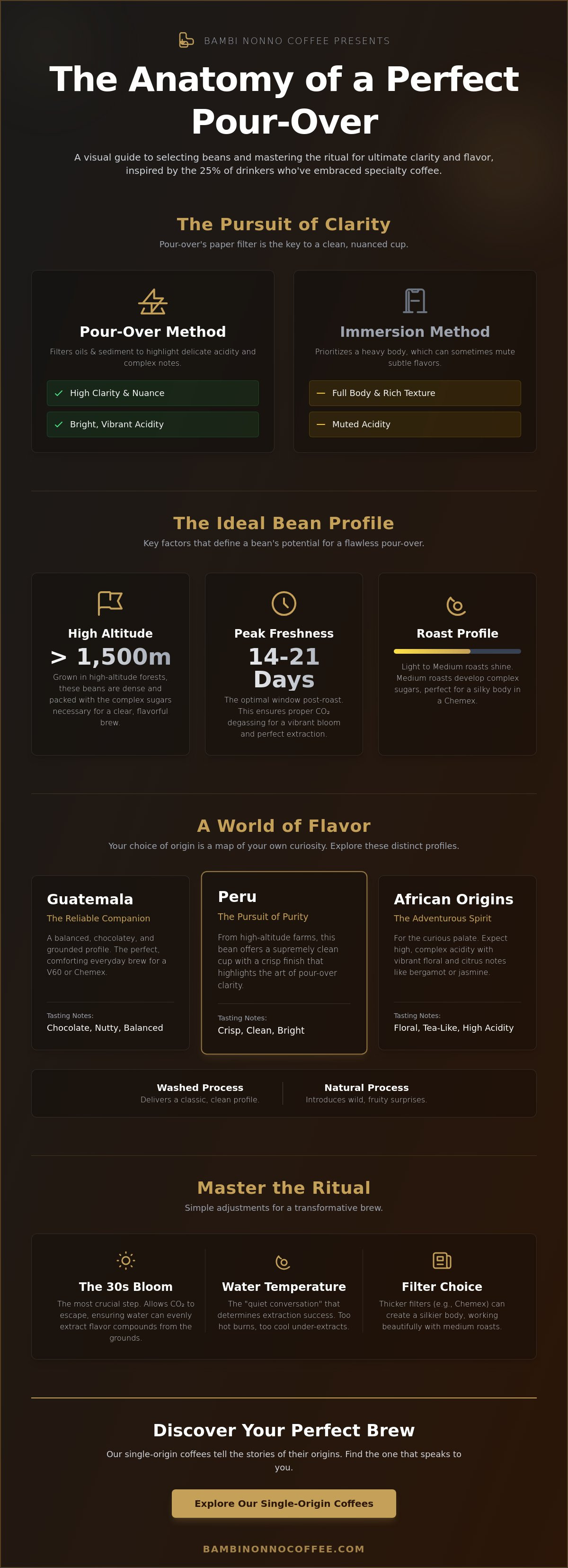
Finding the best coffee for pour over is like choosing the right paper for a handwritten letter; the medium you use dictates how much of the story actually reaches the reader. Manual brewing is uniquely designed to highlight nuance. Unlike immersion methods that prioritize a heavy body, this process uses a paper filter to catch sediment and oils. This allows the delicate acidity and floral notes of the bean to take center stage. To understand the mechanics of the method, it helps to look at What is Pour Over Coffee? and how it differs from standard machine brews.
To better understand this concept, watch this helpful video:
At Bambi Nonno Coffee, our obsession with these details grew from years of quiet mornings spent in different corners of the world. We've learned that the most memorable cups come from a place of curiosity. We don't just look for a label; we look for the history of the harvest. This philosophy of exploration and connection is what drives us to seek out single-origin beans that tell a specific story of their origin through every sip.
Clarity vs. Body: The Manual Brewing Trade-off
The paper filter is your best friend when seeking clarity. By removing oils, it lets you taste the individual notes that roasters describe. High-density beans, often grown in volcanic regions at altitudes above 1,500 meters, are the gold standard here. These beans are physically harder, which means they can handle the steady stream of hot water without over-extracting. Our Peru single-origin is a perfect example, where high-altitude density preserves a crisp, clean finish even during a slow four minute draw down.
The Freshness Factor in Small-Batch Roasting
Freshness isn't just a marketing term; it's a chemical requirement for a successful bloom. We recommend using beans roasted within the last 14 to 21 days. During this window, the coffee is still degassing carbon dioxide at a rate that allows for a vibrant bloom without the gas blocking the water from reaching the flavor compounds. Small-batch roasting ensures these volatile aromatics are captured and delivered to you before they fade into the background. To see this in action, you can explore Kenya AA Supreme for a vibrant example of how small-batch roasting preserves character. It's the difference between a cup that feels alive and one that tastes flat and tired.
Roast Profiles and Origins: Choosing Your Perfect Match
Every morning ritual is personal. When you're Choosing Your Perfect Match, you're deciding on the mood for your day. While many enthusiasts believe the best coffee for pour over must always be a light roast, that's a narrow view that ignores the deep comfort of a well-developed medium roast. Finding the best coffee for pour over is a journey of exploration, not a set of rigid rules.
If you crave balance, our Guatemala Single Origin is a revelation in a V60. It offers a chocolatey, grounded profile that feels like a warm hug from an old friend. For those who prefer a brighter, more energetic start, the Peru Single Origin provides a cleaner cup with a crisp finish that highlights the clarity we discussed in the previous section. We always encourage you to look at the processing method on the label too. Washed coffees often deliver that classic clean profile, while natural processes can introduce wild, fruity surprises.
The Medium Roast Renaissance
Don't let the trend of ultra-light, tea-like brews limit your experience. A medium roast isn't just a darker version of a light roast; it's a different expression of the bean's potential. In a Chemex, the thicker paper filter works beautifully with these roasts to develop complex sugars. This results in a silky mouthfeel that lighter roasts often lack. It's about finding harmony between the bean's natural acidity and the sweetness brought out by the roaster's craft.
Single-Origin Spotlight: Regional Characteristics
Your choice of origin is a map of your own curiosity. Central American beans are your reliable companions. They offer the balance and chocolatey notes needed for an everyday brew. In contrast, African origins are for the adventurous. You can expect high acidity and floral notes that remind you of bergamot or jasmine. Our journey to these regions is more than business. It's about the people we meet and the stories they tell. You can read more about these connections on our Our Story page. If you're ever unsure which path to take for your next brew, feel free to reach out and share your flavor preferences with us.
Brewing for Discovery: Tips to Elevate Your Pour Over
You have selected your beans, perhaps a bright Peru or a grounded Guatemala. Now, the ritual truly begins. Even the best coffee for pour over can have its potential hidden by a rushed process or inconsistent technique. I've found that the most rewarding cups come when you lead with curiosity rather than a strict timer. By changing just one variable at a time, like your pour speed or water temperature, you can see how the story of the bean shifts in your cup. It's a quiet daily habit that turns a simple drink into a moment of genuine discovery.
Temperature is a variable that many hobbyists find intimidating. While traditional advice often suggests waiting exactly two minutes after the kettle whistles, recent scientific research into coffee extraction shows that different roast levels require specific heat profiles to unlock their best flavors. A lighter roast might need water closer to 205°F to pull out those elusive floral notes. In contrast, a medium roast often finds its harmony around 195°F. Finding the best coffee for pour over is only half the battle; the other half is respecting the chemistry of the brew.
The Ritual of the Bloom
When hot water first hits the grounds, the coffee releases trapped carbon dioxide in a sudden, aromatic surge known as the bloom. This 30 second window is your first conversation with the bean. A healthy, bubbling bloom is a reliable indicator that your beans are fresh and the volatile aromatics are still intact. If the grounds stay flat and silent, the coffee has likely aged past its prime, and the resulting cup may taste dull or stale.
Dialing In Your Palate
Mastering your brew doesn't require a laboratory, just your own senses and a bit of patience. Use this quick checklist to troubleshoot your results:
- Too sour or salty? Your grind might be too coarse, causing under-extraction.
- Unpleasantly bitter? Try a slightly coarser grind or cooler water next time to slow down the extraction.
- Muddled or "muddy" flavors? This often points to inconsistent grind size or a pour that was too aggressive.
The few minutes while the coffee drips are a rare gift. I encourage you to start a simple brew journal. Note the origin, the water temperature, and what you tasted in that first sip. Over time, this record becomes a personal map of your own coffee exploration and heritage. Tomorrow morning, try adjusting your water temperature by just three degrees and notice how the sweetness changes.
Start Your Own Ritual of Discovery
Finding the best coffee for pour over is more than a technical challenge; it's an invitation to slow down and connect with the hands that harvested the beans. You've learned that high-altitude density is the secret to clarity and that a careful bloom acts as a window into a coffee's freshness. Whether you choose the chocolatey notes of Guatemala or the crisp finish of Peru, remember that each cup is a story of travel and heritage.
At Bambi Nonno Coffee, we ensure this story is told clearly. Every bag is small-batch roasted in 2026 to guarantee peak freshness when it reaches your door. We responsibly source our beans from high-altitude forests to preserve the delicate flavors you've come to love. We also offer free shipping on all US coffee orders to make your daily discovery even easier. We want to help you build a morning routine that feels like home, no matter where the beans originated.
Have questions about finding your perfect roast? Reach out to us here.
Don't be afraid to experiment with your grind or temperature tomorrow morning. The perfect cup isn't a destination; it's the joy found in the quiet moments of the process.
Frequently Asked Questions
Is light roast or dark roast better for pour over coffee?
Light and medium roasts are generally the preferred choices because they preserve the delicate acidity and floral notes that manual filters highlight. While dark roasts can be used, they often mask the bean's unique origin with smoky or charred flavors. If you're searching for the best coffee for pour over, a light-medium roast from high-altitude regions provides the cleanest expression of the bean's heritage without the heavy, oily texture of darker roasts.
Can I use pre-ground coffee for pour over?
You certainly can use pre-ground coffee, but you'll lose the vibrant bloom that defines a great manual brew. Coffee begins to lose its volatile aromatics within 15 minutes of being ground. To truly experience the nuance of a single-origin bean, we recommend grinding right before you brew. This ensures the carbon dioxide is still present to facilitate a healthy extraction. This simple step preserves the work of the master roaster and the integrity of the harvest.
Why does my pour over coffee taste bitter?
Bitterness usually signals over-extraction, which happens when the water pulls too many compounds from the grounds. This often occurs if your water temperature exceeds 205°F or if your grind size is too fine, causing the water to sit too long in the filter. Try coarsening your grind or using water that has rested for 60 seconds off the boil. Even small adjustments can transform a harsh cup into a smooth, balanced experience that honors the bean.
What is the best water-to-coffee ratio for pour over?
The golden standard for a balanced pour over is a 1:16 ratio, which means 1 gram of coffee for every 16 grams of water. For a standard 300ml cup, you would use roughly 18.7 grams of coffee. This ratio is a great starting point for finding the best coffee for pour over balance. If you prefer a stronger body, try 1:15; for a lighter, tea-like clarity, a 1:17 ratio often works beautifully for delicate origins.