

The Best Coffee for Pour Over: A Guide to Nuance and Ritual in 2026
What if your morning ritual is being held back by a bean that's too shy to tell its story? While specialty coffee accounts for 25% of the U.S. market as of January 2026, many enthusiasts still find themselves staring at a carafe of muddled or overly bitter liquid. Finding the best coffee for pour over isn't just about following a trend. It's about selecting a partner for your V60 or Chemex that thrives under the spotlight of manual brewing, especially as premium Colombian Milds reached 323.01 cents per pound this May.
You already understand that the slow, steady stream of water is a moment to breathe and connect with the craft. It's frustrating when that effort feels wasted on generic blends that lack character. You deserve a cup that reflects the care you put into the process. This guide will show you how to choose beans that highlight the clarity and complex flavors of manual brewing, from high-altitude single origins to artisanal small-batch roasts. We'll explore how to match specific flavor profiles to your palate and how to master the bloom for a vibrant, clean result that honors the journey from the farm to your favorite mug.
Key Takeaways
- Learn why high-altitude beans develop the density necessary to withstand manual extraction while preserving delicate floral and acidic notes.
- Identify the best coffee for pour over by comparing light and medium roast profiles to see which best highlights your preferred flavor clarity.
- Discover why a single-origin Guatemala roast provides the ideal chocolatey balance for a clean, consistent V60 or Chemex brew.
- Master the 30-second bloom to release trapped gases and ensure every drop of water contributes to a vibrant, well-rounded cup.
- Understand how adjusting your water temperature below a rolling boil can prevent over-extraction and reveal the hidden nuances of artisanal beans.
What Makes a Coffee the 'Best' for Pour Over?
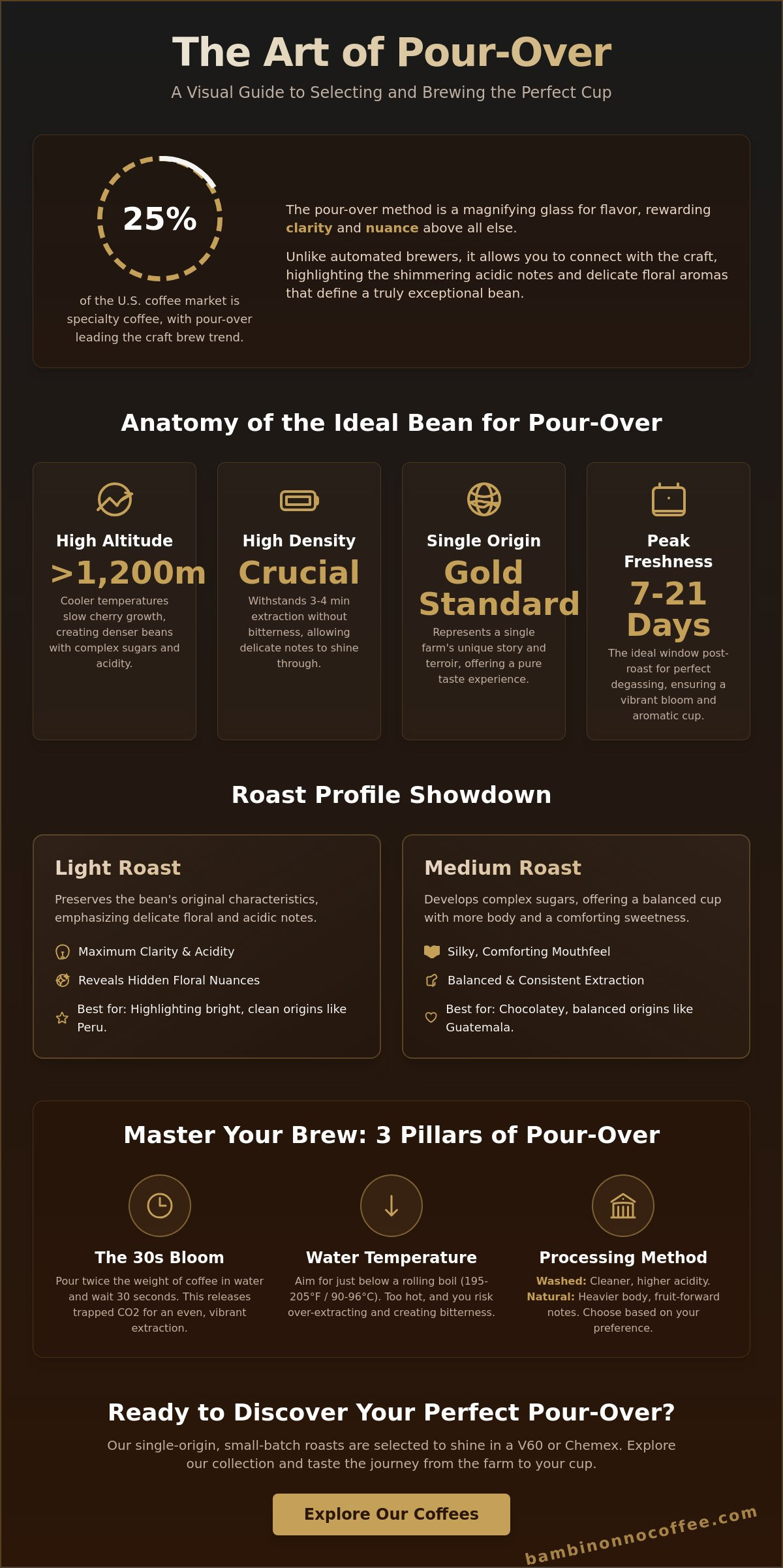
The ritual of manual brewing is a quiet conversation between you and the bean. Unlike automated machines, this process acts as a magnifying glass for flavor. Finding the best coffee for pour over starts with understanding that this method rewards clarity above all else. When you pour water by hand, you're looking for those shimmering acidic notes and floral aromas that often get lost in a standard pot. It's a way to honor the journey the coffee has taken to reach your kitchen.
Our journey at Bambi Nonno Coffee began with a simple obsession born from years of travel, a story you can explore in our story. We've seen firsthand how the finest beans often come from high-altitude forests, typically above 1,200 meters. At these heights, cooler temperatures slow the growth of the coffee cherry. This patience creates a denser bean packed with complex sugars. Single-origin coffees are the gold standard here because they represent a single farm's history. You aren't just drinking a beverage; you're tasting a specific hillside in Ethiopia or a volcanic plot in Guatemala.
Clarity vs. Body: The Manual Brewing Trade-off
When comparing different coffee preparation methods, pour-over stands out because of the paper filter. This filter catches most of the heavy oils and sediment. You lose some "body" compared to a French press, but you gain an incredible amount of flavor definition. High-density beans are essential for this. They have the structural integrity to handle the 3 to 4 minute contact time without over-extracting into bitterness, allowing the delicate notes to shine through clearly.
The Freshness Factor in Small-Batch Roasting
Your success depends heavily on the roast date. For a perfect bloom, you need beans roasted within the last 7 to 21 days. This is when the coffee is at its peak for degassing. If the beans are too old, they won't "bubble" or expand during those first 30 seconds. That lack of activity means the volatile aromatics have already vanished, leaving you with a flat cup. Small-batch roasting at Bambi Nonno Coffee ensures you get that vibrant, living energy every time you brew. It's about catching the coffee at the exact moment it's ready to share its secrets with you.
Roast Profiles and Origins: Choosing Your Perfect Match
Choosing the best coffee for pour over is much like picking a destination for your next journey. You're looking for a profile that matches the specific mood of your morning. While it's common to hear that manual brewing requires ultra-light roasts to be "correct," your preference for a crisp, citrusy finish or a deep, chocolatey sweetness should guide you. There isn't a single right answer, only the one that speaks to your palate.
The Medium Roast Revival
Medium roasts are seeing a significant comeback in the specialty world. By roasting slightly longer, we develop complex sugars that provide a silky, comforting mouthfeel. This is particularly noticeable in a Chemex, where the thick paper filter balances the increased body of a medium roast. Recent scientific brewing discoveries published by the University of Pennsylvania in April 2025 suggest that fluid dynamics within the coffee bed can favor these slightly more developed beans, often leading to a more consistent extraction across the entire filter.
Single-Origin Spotlight: Regional Characteristics
If you're starting your exploration, Central American beans are a reliable and rewarding choice. Our Guatemala Single Origin is a favorite for the V60, offering a balanced, chocolatey profile that feels like a warm embrace. For those who prefer a brighter, cleaner cup that sparkles with clarity, our Peru Single Origin captures the vibrant energy of the high-altitude regions we've visited.
- Washed Process: These beans are typically cleaner and more acidic, perfect for those who value flavor definition.
- Natural Process: These offer a heavier body and wild, fruit-forward notes that can transform your ritual into a bold discovery.
Every bag we roast at Bambi Nonno Coffee is a tribute to the human connections we've built through years of travel, a journey we detail in our story. We believe coffee is a bridge between cultures and generations. If you're feeling stuck between two different origins, we'd love to help you find your perfect match based on how you like to brew.
Brewing for Discovery: Tips to Elevate Your Pour Over
Finding the best coffee for pour over is only half the journey; the rest happens in the quiet minutes before the sun fully rises. Manual brewing is an invitation to slow down and lead with curiosity. Instead of chasing a rigid definition of perfection, treat each cup as an experiment. Change one variable at a time, perhaps the water temperature or the pour speed, and notice how the story in your mug shifts. This process turns a daily habit into a genuine obsession with discovery.
The Ritual of the Bloom
When hot water first touches the grounds, it forces out trapped carbon dioxide to make room for full flavor extraction. A healthy bloom looks like a slow, rhythmic swelling of the coffee bed. This puffing action is the most reliable indicator of freshness you'll ever find. Because we focus on small-batch roasting at Bambi Nonno Coffee, your beans arrive with their cellular structure intact, ensuring a vibrant bloom that releases those volatile aromatics before they fade. If your grounds sit flat and silent, the bean has likely lost its spark.
Dialing In Your Palate
Your grind size is the secret to avoiding a cup that feels "off." If your coffee tastes sharp or sour, your grind is likely too coarse, allowing water to rush through too quickly. If it leaves a lingering, dry bitterness, you've likely ground it too fine, leading to over-extraction. Aim for a consistency similar to coarse sea salt. Pair this with water cooled for about 2 minutes off the boil, ideally between 195°F and 205°F, to protect the delicate sugars from scorching.
- Too Sour? Grind finer or use slightly hotter water next time.
- Too Bitter? Coarsen your grind or pour more gently.
- Muddled Flavors? Check your filter rinse or try a cleaner, washed-process bean.
The beauty of the best coffee for pour over lies in the "quiet everyday moment" it creates. As the water drips, don't rush the clock. To truly master your craft, start a simple brew journal. Note the origin, the temperature, and one word for the flavor. Over time, you'll build a map of your own palate that no expert guide can replace.
Start Your Own Ritual of Discovery
The journey to finding the best coffee for pour over isn't a destination; it's a daily practice of slowing down and paying attention. You've seen how high-altitude beans provide the density needed for clarity and how a 30-second bloom acts as a heartbeat for your brew. Our collection is small-batch roasted throughout 2026 to ensure every bag arrives at your door with peak freshness. We responsibly source each bean from high-altitude forests to honor the land and the families who tend it.
Whether you're reaching for a balanced Guatemala or a vibrant Peru, remember that your palate is the ultimate guide. We want to make your exploration even easier by offering free shipping on all US coffee orders. If you ever feel lost in the nuances of extraction or have questions about finding your perfect roast, reach out to us here. Every cup is a chance to connect with a story from across the globe. Take a breath, pour slowly, and enjoy the quiet magic of a well-made cup.
Common Questions About Manual Brewing
Is light roast or dark roast better for pour over coffee?
Light and medium roasts are typically preferred for manual brewing because they preserve the floral and citrus notes of the bean. Dark roasts often develop heavy oils that can clog paper filters or result in a smoky flavor that masks the delicate origin characteristics. When you're looking for the best coffee for pour over, choosing a roast that highlights acidity rather than charred sweetness will give you a much cleaner, more vibrant cup.
Can I use pre-ground coffee for pour over?
You can use pre-ground coffee, but you'll lose the vibrant aromatics that make manual brewing special. Once a bean is ground, its surface area increases, causing it to oxidize rapidly and lose flavor within 20 minutes. To truly honor the ritual, we recommend grinding your beans immediately before you brew. This ensures the carbon dioxide is still present to create a healthy, active bloom in your carafe every morning.
Why does my pour over coffee taste bitter?
Bitterness is almost always a sign of over-extraction, meaning the water pulled too much from the grounds. This usually happens if your water temperature was above 205°F or if your grind size was too fine, causing the water to sit against the coffee for too long. Try coarsening your grind slightly or letting your kettle sit for an extra 60 seconds after boiling to bring the temperature down to a gentler range.
What is the best water-to-coffee ratio for pour over?
A ratio of 1:16 or 1:17 is the gold standard for a balanced, specialty-grade extraction. This means for every 1 gram of coffee, you'll use 16 or 17 grams of water. If you're brewing a standard 300ml cup, start with roughly 18 grams of coffee. Using a digital scale is the only way to ensure this consistency every morning, allowing you to replicate the best coffee for pour over experience without guessing.