

The Bold Soul of Italian Roast Coffee: A Guide to the Darkest Roast
The darkest roast in your cabinet isn't an attempt to hide a bean's flaws; it's a high-stakes technical achievement that requires more precision than any light roast ever will. You've likely felt the frustration of oily beans clogging your expensive grinder or suffered through a cup that tasted more like charcoal than a morning ritual. It's no surprise that by 2025, dark roast consumption dropped to 38% as many enthusiasts sought the clarity of lighter profiles. However, when handled with patience and soul, italian roast coffee offers a deep, warming intensity that lighter beans simply cannot reach.
I want to help you rediscover this bold classic without the acrid bitterness. We'll look at the technical craft of the second crack roasting stage and how to spot high-quality beans that retail for the current $15.00 to $20.00 market average without sacrificing your equipment's health. You'll learn how to master extraction to pull out those elusive smoky notes while keeping the cup smooth. Let's slow down and explore how to turn this intense roast into your favorite quiet moment of the day.
Key Takeaways
- Define what makes an italian roast coffee unique by looking beyond the dark color to the visible oils and mahogany hues.
- Understand the second crack phenomenon and how small-batch roasting prevents charring while maximizing intensity.
- Learn why lowering your brewing temperature to 195°F (90°C) is the secret to a smooth, smoky cup.
- Adjust your grind size to manage extraction and ensure your darkest roast tastes rich rather than bitter.
Understanding the Depth of Italian Roast Coffee
Italian roast coffee represents the final frontier of the roaster's art. It is the technical peak where heat and time transform a green bean into a deep, mahogany treasure. You'll notice a distinct shimmer on these beans; this isn't an additive but rather the coffee's own lipids. As the roast progresses, the cellular structure of the bean breaks down, pushing these natural oils to the surface. It's a visual cue that the coffee has reached its most intense state, even as global trends in 2025 showed a 10% shift toward lighter roast preferences.
Many people assume the name implies a specific bean from Europe, but it actually describes a roasting style. Whether the beans were harvested in Ethiopia or Peru, the term "Italian" tells you how they were treated in the drum. It is the darkest of the dark. This method prioritizes the flavor of the fire and the caramelization of sugars over the subtle floral notes of the origin. It requires a watchful eye to ensure the beans reach this stage without becoming charred or flat.
To better understand this concept, watch this helpful video:
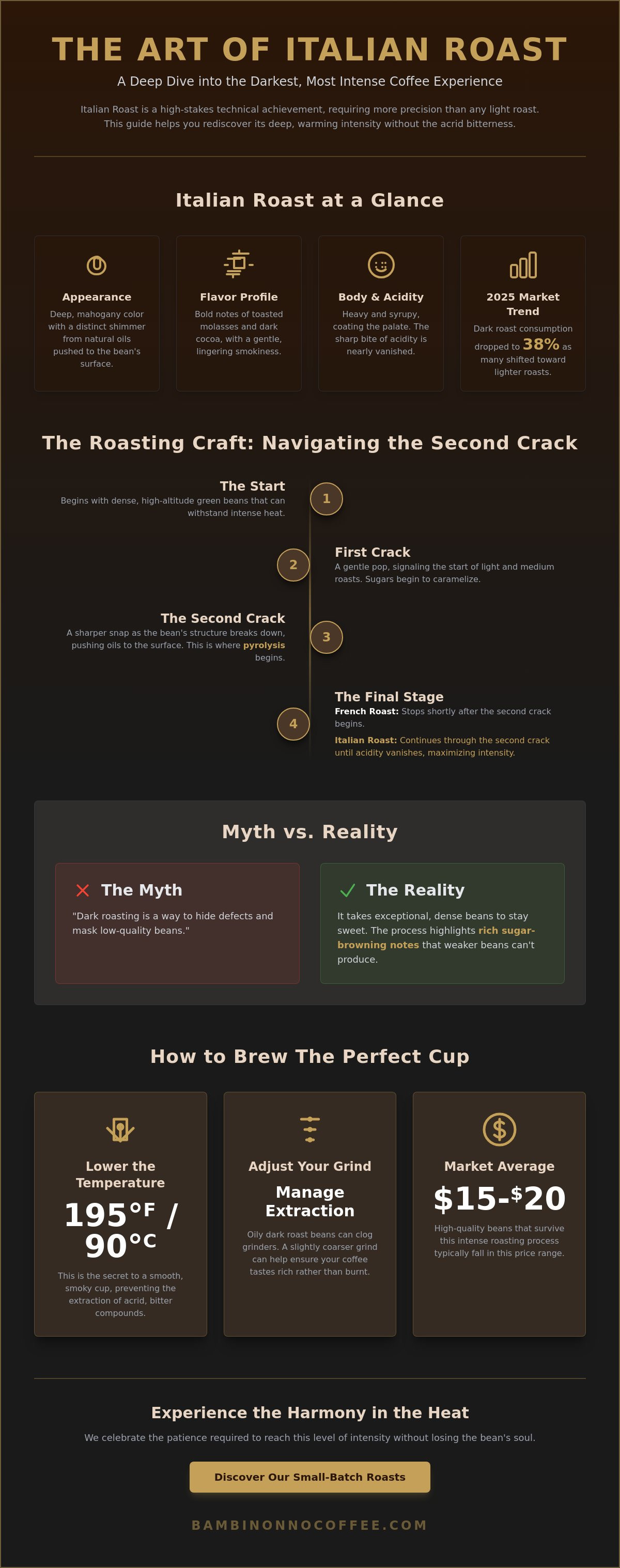
The difference between a French roast and an italian roast coffee comes down to the duration of the second crack. In The Roasting Craft, this stage is where the beans literally snap under the pressure of expanding gases. While a French roast stops shortly after this begins, an Italian roast stays in the heat until the acidity is nearly vanished. The result is a cup that feels substantial on the tongue, lacking the sharp bite found in medium roasts.
The Profile: Beyond the Bitterness
If you've only had poorly roasted dark coffee, you might expect a one dimensional charred taste. A well executed Italian roast offers a much deeper palette. You'll find notes of toasted molasses and dark cocoa, wrapped in a gentle, lingering smokiness. The body isn't thin or tea-like; it's heavy and syrupy, coating the palate with a richness that stands up beautifully to cream or milk.
This pursuit of bold, uncompromising flavor is central to the Bambinonno story. Our founder spent years traveling and exploring how different cultures embrace the ritual of a strong cup. We don't see dark roasting as a way to hide beans. We see it as a way to celebrate the patience required to reach this level of intensity without losing the bean's soul. It's about finding harmony in the heat.
The Roasting Craft: Navigating the Second Crack
The roastery is a place of quiet focus until the second crack begins. This isn't the gentle, rhythmic pop of the first stage; it's a sharper, more frequent snap that signals the bean's cellular walls are finally yielding to the heat. This structural break is what allows those glossy oils to migrate to the surface, giving italian roast coffee its iconic shimmer. To achieve a true dark roast coffee, we must stay in this heat just long enough to initiate pyrolysis. This is the chemical breakdown where organic materials decompose under high temperatures, creating the intense, smoky compounds that define the style.
Precision is everything when the drum is this hot. We rely on small-batch roasting because it allows for total control over heat distribution. In larger, industrial setups, you often see "tipping," where the intense heat chars the delicate ends of the bean before the center is fully developed. This leads to an acrid, burnt taste that masks the coffee's soul. To survive this trial by fire, we start with dense, high-altitude seeds like our Nicaragua single-origin. These beans grow slower in thinner air, developing a physical hardness that can withstand the Maillard reaction's final, aggressive stages without falling apart.
The Myth of Hiding Defects
There's a common misconception that dark roasting is simply a mask for low-quality crops. We believe the opposite is true. While some industrial roasters might use high heat to cover up old or inconsistent beans, a specialty roaster uses intensity to highlight specific sugar browning notes. It takes an exceptional bean to stay sweet after such high heat. Sometimes, a carefully crafted blend is the best choice for this profile. By combining beans with different structural strengths, we create a cup with enough integrity to remain balanced, rich, and oily. Small-batch roasting ensures your italian roast coffee maintains a consistent profile from the first bean to the last.
Finding that perfect balance between smoke and sweetness is a journey we've been on for years. If you're curious about how we select the specific lots that make the cut for our darkest profiles, you can always reach out to us directly with your questions.
Perfecting the Extraction: Brewing Your Darkest Roast
Brewing an italian roast coffee requires a gentler touch than you might expect for such a bold profile. Because these beans have spent more time in the roaster, their structure is more porous, making them highly soluble. This means they give up their flavors very quickly. If you use boiling water, you'll likely pull out the harsh, ashy notes you're trying to avoid. Aim for a water temperature around 195°F (90°C). This lower heat coaxes out the toasted molasses and cocoa without scalding the delicate oils.
Your grind size plays a vital role when brewing your darkest roast. A slightly coarser setting prevents the water from over-extracting the bitter compounds. Combined with a shorter brew time, this ensures you capture the sweetness of the Maillard reaction we discussed earlier. Don't forget the bloom. Giving the grounds 30 seconds to breathe allows gases to escape, ensuring the water can fully saturate the coffee and interact with those beautiful surface oils.
Best Brewing Methods for Italian Roast
The French Press is perhaps the most nostalgic way to enjoy this profile. This immersion brewing highlights the heavy body and oils of your italian roast coffee, allowing them to pass through the metal filter and create a deeply textured cup. It's a slow, rewarding ritual that fits the Bambinonno philosophy of taking time for what matters.
This philosophy of slow, intentional enjoyment is a hallmark of Italian culture, whether you are savoring a rich espresso or enjoying a traditional meal at Amore Mio.
If you prefer a standard drip brewer, you can still achieve a bold morning cup. Use a high-quality paper filter to catch some of the sediment while letting the smoky aroma shine. For those who enjoy this level of depth but want to explore even more layers, our 6 Bean Blend guide explains how combining different origins can create a similarly rich experience.
Try decreasing your usual steep time by 30 seconds tomorrow morning. You might find that a shorter visit with the water reveals a hidden sweetness you've been missing.
Embracing the Ritual of the Dark Roast
You now have the tools to transform your morning from a bitter habit into a rich, smoky experience. By respecting the second crack and adjusting your brew temperature to 195°F, you can finally enjoy the true depth of italian roast coffee. It isn't about hiding the bean; it's about honoring the patience required to reach that perfect mahogany finish. This roast is a testament to the idea that the best things in life take time and a gentle hand.
Every bag we offer is small-batch roasted in the USA and sourced from responsible high-altitude forests to ensure that intensity never comes at the cost of quality. We want your experience to be seamless, which is why we provide free shipping on all coffee orders. Whether you're brewing for yourself or sharing a cup with a loved one, these bold profiles are meant to be savored slowly.
If you're ready to find your new favorite cup, explore our hand-roasted blends for your next morning ritual. Coffee is a journey that connects us all, and we're honored to be a part of your daily discovery.
Frequently Asked Questions
Does Italian roast coffee have more caffeine than light roast?
Italian roast coffee actually contains slightly less caffeine by volume than lighter roasts. As beans spend more time in the roaster, they lose density and expand in size. While the caffeine molecule itself is quite stable, the roasting process reduces the overall mass. If you measure your coffee by the scoop, you're getting fewer beans and therefore less caffeine. If you measure by weight, the difference is typically less than 1%.
Why are Italian roast coffee beans so oily?
The oil on the surface of your beans is a natural result of the internal pressure built up during the roasting process. When the beans reach the second crack, usually around 440 degrees Fahrenheit, the cellular structure breaks down. This allows internal lipids to migrate to the surface, creating that characteristic shimmer you see on a high quality italian roast coffee. These oils carry the smoky, toasted molasses flavors that dark roast enthusiasts love.
What is the difference between French roast and Italian roast?
The primary difference lies in the duration of the roast after the second crack begins. French roast is pulled from the drum shortly after that audible snap, while an Italian roast stays in the heat for an additional 30 to 60 seconds. This extra time reduces the acidity even further and results in a heavier, more syrupy body. It is the most intense profile you can find before the bean simply turns to ash.
Is Italian roast coffee only meant for espresso?
No, this roast profile is versatile enough for many home brewing methods if you adjust your technique. While it's a staple for traditional espresso, it performs beautifully in a French Press where the immersion highlights those surface oils. Many of our friends enjoy a cup of italian roast coffee from a standard drip machine for a bold morning ritual. Just remember to keep your water temperature at exactly 195 degrees to keep the flavor profile smooth.