

What is Specialty Coffee? A Guide to the Craft, Flavor, and Ritual
If you're spending an average of $32.75 on a pound of roasted beans in 2026, are you buying a marketing story or a genuine craft? It's frustrating to stand before a shelf of beautiful bags and feel more confused than inspired. You've likely felt the sting of an expensive bag that tastes like nothing but disappointment when you brew it at home. You want to know what is specialty coffee without the gatekeeping or the jargon that makes the industry feel cold. We see coffee as a quiet, daily habit that connects us to distant lands and shared memories. It's about the ritual of a good cup that reminds you of a slow morning spent traveling and exploring. This guide will help you navigate the technical 80-point grading system and the 2026 SCA updates on extraction ratios and water chemistry. We'll show you how to spot the difference between a generic roast and a bean that's been cared for from the farm to the roast master's hands. You'll leave with the confidence to choose beans that turn your kitchen into a place of discovery and warmth.
Key Takeaways
- Learn why an 80-point SCA score is the baseline for quality and how to identify it on your next bag.
- Understand how terroir and high-altitude growth create the complex flavor notes found in your favorite single-origin varieties.
- Discover how small-batch roasting protects the delicate Maillard reaction to ensure your morning cup is never flat or over-roasted.
- Elevate your daily ritual by mastering the bloom and extraction techniques that turn a simple habit into a moment of discovery.
- Get a clear, jargon-free definition of what is specialty coffee by tracing its journey from the farm to the 2026 brewing standards.
Defining the Standard: The 80-Point Journey of Specialty Coffee
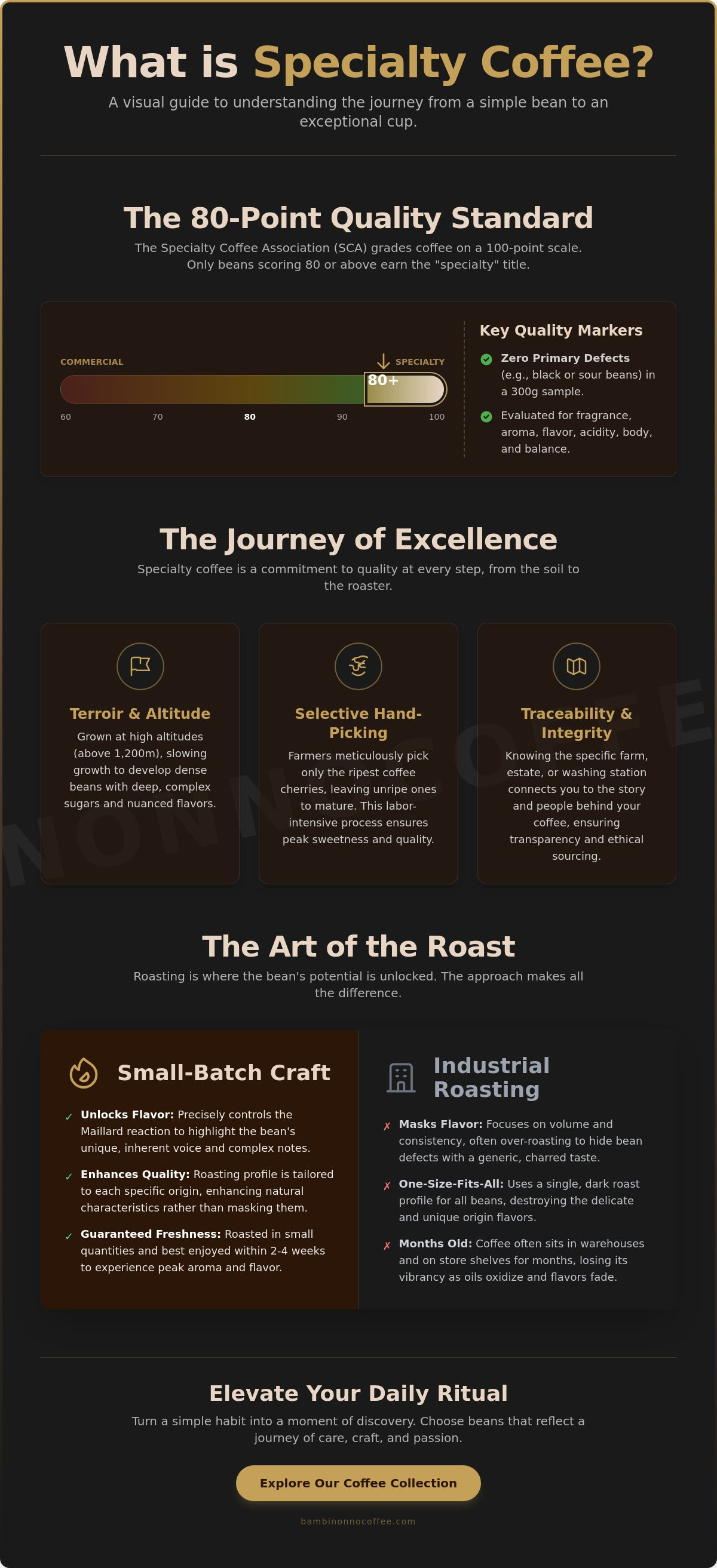
Most of us start our day with a cup of coffee, but few realize that a technical score defines the quality of those beans. To truly understand what is specialty coffee, we have to look at the Specialty Coffee Association (SCA) 100-point scale. Only beans that score 80 points or higher earn this title. This rigorous grading process evaluates everything from fragrance and aroma to acidity and body. It's a high bar that separates commercial grade coffee from the vibrant, complex beans that make your morning ritual special.
This journey begins in the soil. The terroir, which includes unique micro-climates and high-altitude forests, dictates the bean's character. High altitudes, typically above 1,200 meters, slow down the growth of the coffee cherry. This patience allows the sugars to develop more deeply; the result is a denser bean with more nuanced flavors. Specialty coffee is a holistic commitment that starts with healthy soil and ends with a roaster's dedication to preserving that natural potential.
To better understand this concept, watch this helpful video:
The standard also demands perfection in the physical beans. A 300-gram sample of green specialty coffee must have zero primary defects, such as sour or black beans. This level of scrutiny ensures that your cup is clean and free from the bitter, off-putting flavors found in mass-produced blends. It's about respecting the bean at every stage of its life. When you ask what is specialty coffee, you're really asking about a pursuit of excellence that leaves no room for compromise.
The Human Element: Sourcing with Integrity
Quality isn't just about the environment; it's about the hands that touch the crop. Farmers who specialize in this craft practice selective hand-picking, choosing only the ripest cherries while leaving the green ones on the branch. This labor-intensive process is a testament to their dedication. Traceability is the final piece of the puzzle. When you know the specific estate or washing station where your coffee was processed, you aren't just drinking a beverage. You're participating in a story of hard work and exploration. You can learn more about our own journey and dedication to quality in Our Story. We believe that every cup should reflect the personal relationships and travels that brought the bean to your kitchen.
The Art of the Roast: How Small-Batch Craft Unlocks Flavor
If the 80-point grading system is the foundation, the roasting process is where the soul of the bean truly wakes up. Industrial roasting is a game of volume. It often hides the bean's flaws by roasting it dark and oily, resulting in a generic, charred taste. In contrast, when we talk about what is specialty coffee, we're looking at a craft that prioritizes the bean's unique voice. Small-batch roasting gives us the control needed to master the Maillard reaction. This is the chemical dance between amino acids and reducing sugars that creates those complex, savory, and sweet aromas you love. We aren't just heating beans; we're listening to them.
Timing is everything. A development time that's even thirty seconds too long can turn a vibrant Guatemala into a bitter disappointment. We treat each origin differently. A bright, high-altitude bean from Central America needs a delicate touch to preserve its citrusy acidity. Meanwhile, a smooth and earthy Peru requires a profile that highlights its deep chocolate notes. The Specialty Coffee Association emphasizes that roasting should enhance, not mask, the inherent quality of the green bean. It's a balance of science and intuition that takes years of travel and tasting to perfect.
Freshness is your best friend in this journey. While grocery store coffee might sit on a shelf for months, specialty beans are at their peak within two to four weeks of roasting. After that, the delicate oils begin to oxidize, and those vibrant flavors start to fade. If you ever have questions about a specific roast date or profile, feel free to reach out and chat with us about your preferences.
Flavor Profiles and the Joy of Discovery
The "Third Wave" of coffee has changed how we think about our morning cup. It's no longer just a caffeine delivery system; it's an exploration. Specialty coffee celebrates natural tasting notes like jasmine, stone fruit, or raw honey without any artificial additives. These flavors are snapshots of a specific place and time. When you brew a single-origin bean, you're tasting the rain, the soil, and the sun of that specific harvest. It's a way to travel the world from your kitchen table, one sip at a time. Every new bag is an opportunity to discover something you've never tasted before.
Elevating Your Ritual: Bringing Specialty Quality to Your Kitchen
You've seen the scores and understood the roasting craft. Now, how do you bridge the gap between the farm and your kitchen? Truly understanding what is specialty coffee means recognizing that the journey doesn't end when the bag is sealed. It continues with the intention you bring to your morning brew. Respecting the work of the farmer and roaster is as simple as paying attention to your bloom. When you pour that first bit of water, watch the coffee expand as it releases trapped gases. This small act ensures your extraction is even and vibrant, allowing the bean's natural character to shine through.
While the industry defines specialty coffee through rigorous cupping and technical standards, your kitchen is a place for curiosity. Don't feel pressured to follow every "rule" perfectly from the start. Your palate is the ultimate judge of the perfect cup. If a brew tastes too sharp, try a slightly finer grind next time. This process of experimentation turns a simple caffeine habit into a genuine hobby. We encourage you to view your morning coffee as a moment of slow-living, a quiet space in a busy world where you can simply be present with your thoughts.
The Tools of the Trade
You don't need a lab full of equipment to honor high-scoring beans. A burr grinder is the most impactful investment you can make. It provides the uniform particle size needed for clarity, unlike blade grinders that create inconsistent dust. Combine that with filtered water to ensure minerals don't mask those delicate notes of stone fruit or chocolate we discussed earlier. Whether you prefer the clean clarity of a pour-over or the heavy balance of a French press, the goal is to find a method that fits your rhythm. You can find your next favorite roast at Bambi Nonno Coffee and begin your own exploration of what is specialty coffee today. Every cup is a chance to discover a new favorite corner of the world.
Your Morning Ritual Awaits
You now understand that what is specialty coffee isn't just a marketing label; it's a commitment to quality that spans from high-altitude forests to your favorite mug. It's the difference between a generic caffeine fix and a vibrant, single-origin experience that tells a story of travel and care. By choosing beans that score above 80 points and respecting the bloom during your brew, you're honoring a craft that celebrates human connection and the joy of discovery.
We take this responsibility personally. Our beans are responsibly sourced from high-altitude estates and small-batch roasted in the USA to ensure every bag is at its peak when it reaches your door. Plus, we offer free shipping on all coffee orders to make your journey into better coffee even easier. If you're ready to explore these nuanced flavors and elevate your daily habit, you can discover our small-batch roasted specialty blends and single-origin favorites today. Let your next cup be a reason to slow down and enjoy a quiet moment of discovery.
Frequently Asked Questions
Is specialty coffee the same as gourmet coffee?
No, specialty coffee and gourmet coffee are distinct categories. Gourmet is a marketing label with no technical requirements, while what is specialty coffee is a grade verified by certified Q Graders. Specialty beans must score at least 80 points on the SCA scale. This ensures you're investing in a product with zero primary defects, unlike gourmet brands that often use lower-quality beans hidden behind dark roast profiles to mask inconsistencies.
What does an 80-point score actually mean for the taste?
An 80-point score is the threshold for a clean and balanced cup. It means the coffee has been sensory-evaluated to ensure it lacks the bitter or fermented "off" flavors found in commodity coffee. For your morning ritual, this score translates to clarity. You'll be able to taste the specific terroir of the region. This might be the bright citrus of a high-altitude forest or the deep, natural sweetness developed through careful processing.
Why is specialty coffee usually more expensive than grocery store brands?
The price reflects the immense care and labor involved in the craft. In March 2026, the average price for roasted specialty coffee hit $32.75 per pound. This investment supports selective hand-picking and sustainable farming practices that protect the land. With 66% of US adults drinking coffee daily in 2026, many are shifting toward these higher-quality beans because they value a transparent supply chain that rewards the farmer's expertise and long-term dedication.
How can I tell if the coffee I'm buying is actually specialty grade?
Look for transparency on the packaging. A specialty bag will almost always list a specific roast date, the altitude of the farm, and the processing method used. If a label only says "100% Arabica" without a specific estate or region, it's probably not specialty grade. High-quality roasters share these details because they're proud of the journey the bean took to reach your kitchen. Check for tasting notes that describe natural characteristics like jasmine or stone fruit.