

What is Specialty Coffee? A Guide to the Craft and the Ritual
Recent data from April 2026 shows that 58% of American adults enjoyed a specialty coffee in just the past week. It's a staggering number that proves many of us are looking for something more meaningful in our morning cup. You likely already appreciate the difference a high-quality bean makes, but it's easy to feel overwhelmed by industry jargon and inconsistent results when you're brewing at home. We know the frustration of trying to distinguish real quality from marketing hype when all you want is a reliable, delicious ritual.
We're here to help you turn that confusion into a quiet moment of clarity. You'll discover the journey of specialty coffee from high-altitude forests to your morning cup, and learn how to elevate your daily ritual by stripping away the noise. We'll explain the 80-point quality scale in plain English and show you how to choose beans that truly match your palate. We'll also explore the dedicated craft behind the roast and give you the confidence to master your home extraction every single morning.
What's Inside
Before we dive into the craft, here's a glimpse of what you'll learn about the journey of specialty coffee and how to make it part of your own daily ritual.
- How the 80-point scale honors the care behind every bean, seeing it as a measure of heart and potential rather than just a cold grade.
- Why quiet, high-altitude forests are the secret to the dense and flavor-rich beans that define specialty coffee.
- The artistry of small-batch roasting, where patience and control over the Maillard reaction unlock the bean's hidden stories.
- How to move past the pressure of "perfect" rules and embrace a ritual of curiosity, finding the brewing methods that speak to your own palate.
Defining Specialty Coffee: Why Every Bean Has a Story to Tell
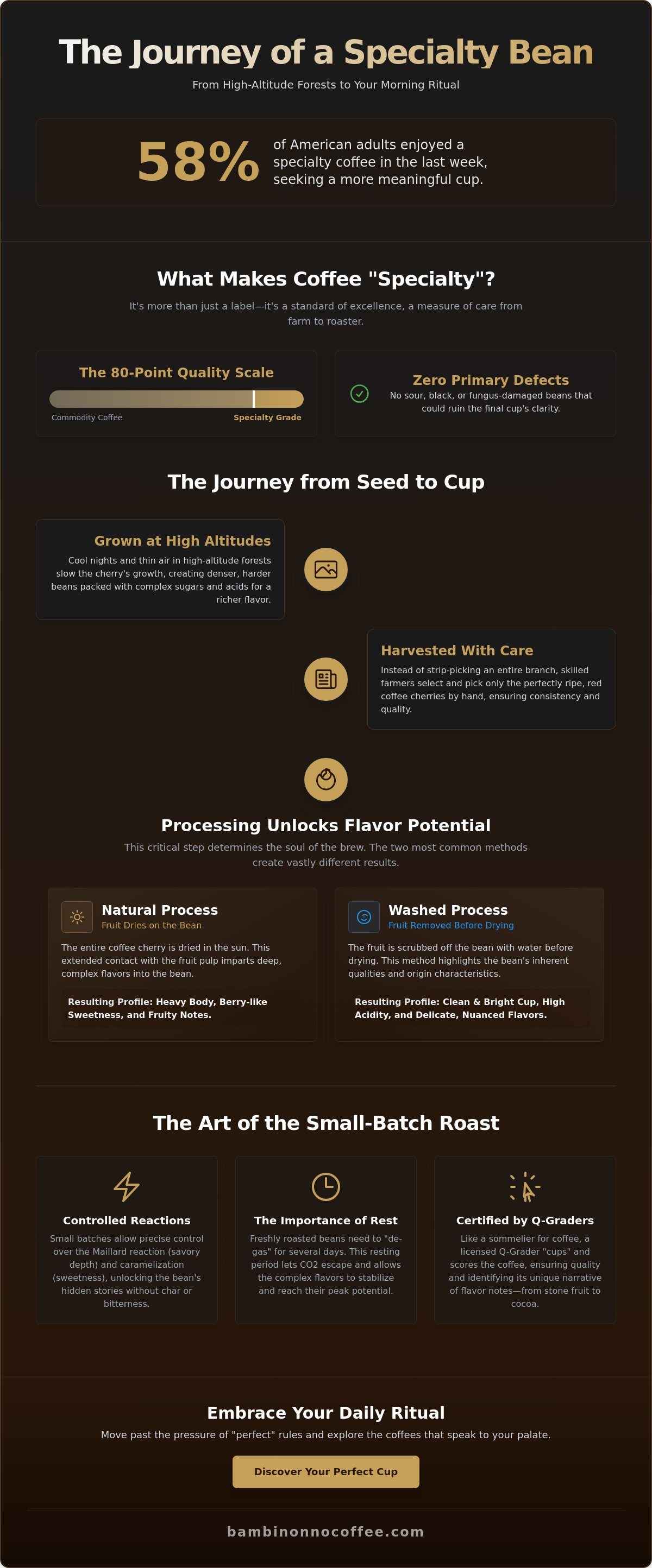
When we talk about specialty coffee, we're looking at a score of 80 points or higher on a 100-point scale. But it's more than a number. Think of it as a measure of potential. It represents the collective care of everyone who touched the bean. To earn this title, the green coffee must have zero primary defects. That means no black beans or sour beans that could ruin the clarity of the flavor. Most of these exceptional crops grow in high-altitude forests. The thin air and cool nights slow down the growth of the coffee cherry. This patience from nature creates a denser, harder bean packed with sugars and complex acids.
Traceability is the thread that connects you to the source. It's the difference between a generic blend and knowing exactly which hillside or small family lot your beans called home. When you know the origin, you aren't just buying a product; you're participating in a legacy of farming that spans generations.
The Journey from Seed to Cup
The story begins with the careful picking of only the ripest red cherries. Once harvested, the drying process dictates the soul of the brew. In natural processing, the fruit dries while still on the bean, lending a heavy body and deep, berry-like sweetness. Washed coffee removes the fruit first, resulting in a cleaner, brighter cup that highlights the bean's inherent acidity. This deep respect for the process is at the heart of the multicultural roots of our story. Every cup is a bridge between different worlds and quiet daily habits.
The Role of the Q-Grader
You can think of a Q-Grader as the sommelier of the coffee world. These licensed experts use a standardized process called cupping to evaluate the beans. They aren't just looking for quality; they're uncovering a narrative. During a session, they might identify delicate notes of stone fruit in an Ethiopian lot or the deep, comforting scent of cocoa in a South American harvest. Their expertise ensures that every bag of specialty coffee delivers on its promise of a unique sensory experience.
The Art of the Roast: Why Small-Batch Production Changes Everything
Industrial roasting is a race for volume. Nuance is often the first thing to go in the rush to fill shelves. Small-batch roasting is different. It’s a quiet, focused craft that treats every bean with the respect it deserves. Roasting in small amounts gives us total control over the Maillard reaction. This is the chemical dance between amino acids and sugars that creates those deep, savory flavors. We also watch the caramelization process closely. This ensures the inherent sweetness of your specialty coffee shines through without being buried by char or bitterness.
While freshness matters, timing is just as vital. When beans leave the roaster, they’re full of carbon dioxide. This leads to the bloom you see when hot water first hits the grounds. While that gas release is vital for a good extraction, the coffee also needs time to breathe. Resting your beans for a few days allows the flavors to stabilize and reach their peak. It’s a gentle reminder that the best things in life usually require a bit of patience and a slower pace.
Preserving Terroir Through Precision
Think of terroir as a beautiful word for the environment that shaped the bean. It’s the volcanic soil, the morning mist, and the specific altitude of the high-altitude forests where the cherries ripen. We use light and medium roasts to act as a stage for these unique traits. This approach is why Ethiopia Natural beans taste so remarkably like fresh berries and sun-warmed fruit. If you want to dive deeper into the technical side of this process, our guide on small batch roasted coffee beans explains the science behind the craft.
Developing Complexity in Blends
Crafting a blend with specialty coffee is like writing a story. You need characters that complement each other. We look for beans that bring different strengths to the table, ensuring they interact harmoniously rather than competing for attention. Our 6 bean blend shows how multiple origins can create a cup that’s far more complex than the sum of its parts. If you're ever curious about finding your perfect match, you can always reach out and ask us for a personal recommendation.
Embracing the Ritual: How to Explore Specialty Coffee at Home
Bringing specialty coffee into your home shouldn't feel like a chemistry exam. It’s an invitation to slow down and listen to what the beans have to say. While the industry often talks about rigid rules, we prefer to think of brewing as a series of gentle experiments. You might find that a French press brings out a heavy, comforting body, while a simple drip method highlights a cleaner, more delicate finish. The beauty is in the discovery, not just the destination.
Consistency is the secret to refining your palate. A quality burr grinder is the most important tool you can own because it ensures every particle of coffee is the same size. This leads to an even extraction, preventing that confusing mix of sour and bitter notes. Don't forget the water, either. Using water that's just off the boil acts as a key that unlocks different layers of flavor. A slightly lower temperature can tame a bold roast, while a hotter pour can coax out the bright acidity in a lighter bean.
Finding Your Preferred Flavor Profile
Are you drawn to bright, citrusy notes that wake up your senses, or do you prefer something deep and chocolatey that feels like a warm hug? Exploring a single origin coffee delivery allows you to travel the world from your kitchen. You can taste the difference between the crisp, apple-like acidity of a lot from Guatemala and the smooth, herbal sweetness found in beans from Peru. If you're ready to start your own sensory journey, our Single Origin collection is a great place to find your next favorite story.
The Daily Habit as a Moment of Discovery
At Bambi Nonno Coffee, we see coffee as a bridge. Our name reminds us that coffee connects the curiosity of youth with the wisdom of tradition. It’s a multicultural legacy born from years of travel and quiet daily habits. Try a "slow sip" tomorrow morning. As your cup cools, the flavors will shift and evolve. A specialty coffee that starts with a cocoa-like warmth might finish with a surprising hint of stone fruit. Take five minutes to just notice those changes.
Try brewing your favorite beans at two different temperatures this weekend. You might be surprised at how much sweetness you can unlock just by turning the heat down a few degrees.
Start Your Own Sensory Journey
We've explored how specialty coffee is far more than just a high score on a grading sheet. It's a commitment to quality that begins in high-altitude forests and ends in the quiet comfort of your kitchen. By understanding the care behind small-batch roasting and the simple chemistry of home brewing, you've turned a standard morning habit into a meaningful ritual. You're no longer just drinking a beverage. You're participating in a multicultural story that spans continents and generations.
Our beans are small-batch roasted in the USA, ensuring that every bag arrives with its vibrant flavors fully intact. We focus on responsible sourcing from high-altitude forests to honor the land and the farmers who make this craft possible. We also offer free shipping on all coffee orders to make your discovery even easier. If you're ready to find a new favorite, explore our small-batch specialty blends and single-origin favorites to see which story speaks to you. There's a world of flavor waiting in your next cup, and we can't wait to hear what you discover.
Frequently Asked Questions
What is the difference between specialty coffee and commercial coffee?
Specialty coffee is defined by its quality score of 80 or above, whereas commercial coffee is mass-produced for volume and shelf life. While commercial brands prioritize a uniform taste through dark roasting, specialty roasters focus on the unique stories of single-origin beans. This dedication ensures that the subtle notes of the high-altitude forests aren't lost in a generic blend.
Why is specialty coffee more expensive than grocery store brands?
The higher cost reflects the intensive labor and meticulous care required at every stage of the journey. From hand-picking only ripe cherries to small-batch roasting in the USA, every step is more expensive than industrial methods. You're also paying for traceability and the assurance that farmers are compensated fairly for their exceptional craftsmanship and dedication to quality.
Does specialty coffee have more caffeine than regular coffee?
Specialty coffee usually has a lower caffeine content because it relies on Arabica beans rather than the Robusta beans found in commercial cans. Arabica offers a much wider range of flavors, from stone fruit to cocoa, but it naturally contains less caffeine. It's the perfect choice for those who want to enjoy several cups throughout the day as part of a slow, mindful ritual.
How long does specialty coffee stay fresh after roasting?
Whole bean coffee is at its peak between one and four weeks after the roast date. During this time, the gases from the roasting process are balanced, allowing for a perfect bloom and extraction. Once you grind the beans, they begin to lose their aromatic oils within minutes. It's best to buy smaller amounts frequently to ensure your daily cup stays as vibrant as possible.