

Why Is There No Crema on My Espresso? How to Fix It
You lock in the portafilter, start the pump, and watch a thin, pale stream run straight through into your cup. If you're standing in your kitchen wondering why is there no crema on my espresso, you're not alone. That flat, watery pour feels frustrating, especially when it feels like you're wasting freshly roasted specialty beans just trying to diagnose what went wrong.
Crema isn't an elusive badge of espresso perfection; it's simply carbon dioxide gas and natural oils meeting the right water pressure. You'll learn the exact reasons your espresso lacks crema and how to dial in fresh beans, grind size, and pressure at home. Here is how to quickly diagnose the root cause and get your morning extraction back on track.
Key Takeaways
- Understand the underlying science behind why is there no crema on my espresso, focusing on roast freshness and natural carbon dioxide retention.
- Learn how maintaining 9 bars of pressure and a 25 to 30 second brew time emulsifies coffee oils into a rich, lasting layer.
- Dial in your grind size and basket dose to prevent channeling and stop wasting specialty beans on thin, watery shots.
- Discover why crema is a diagnostic clue rather than the ultimate measure of flavor, helping you prioritize balanced taste in every cup.
The Chemistry of Crema: Why Freshness and Pressure Matter
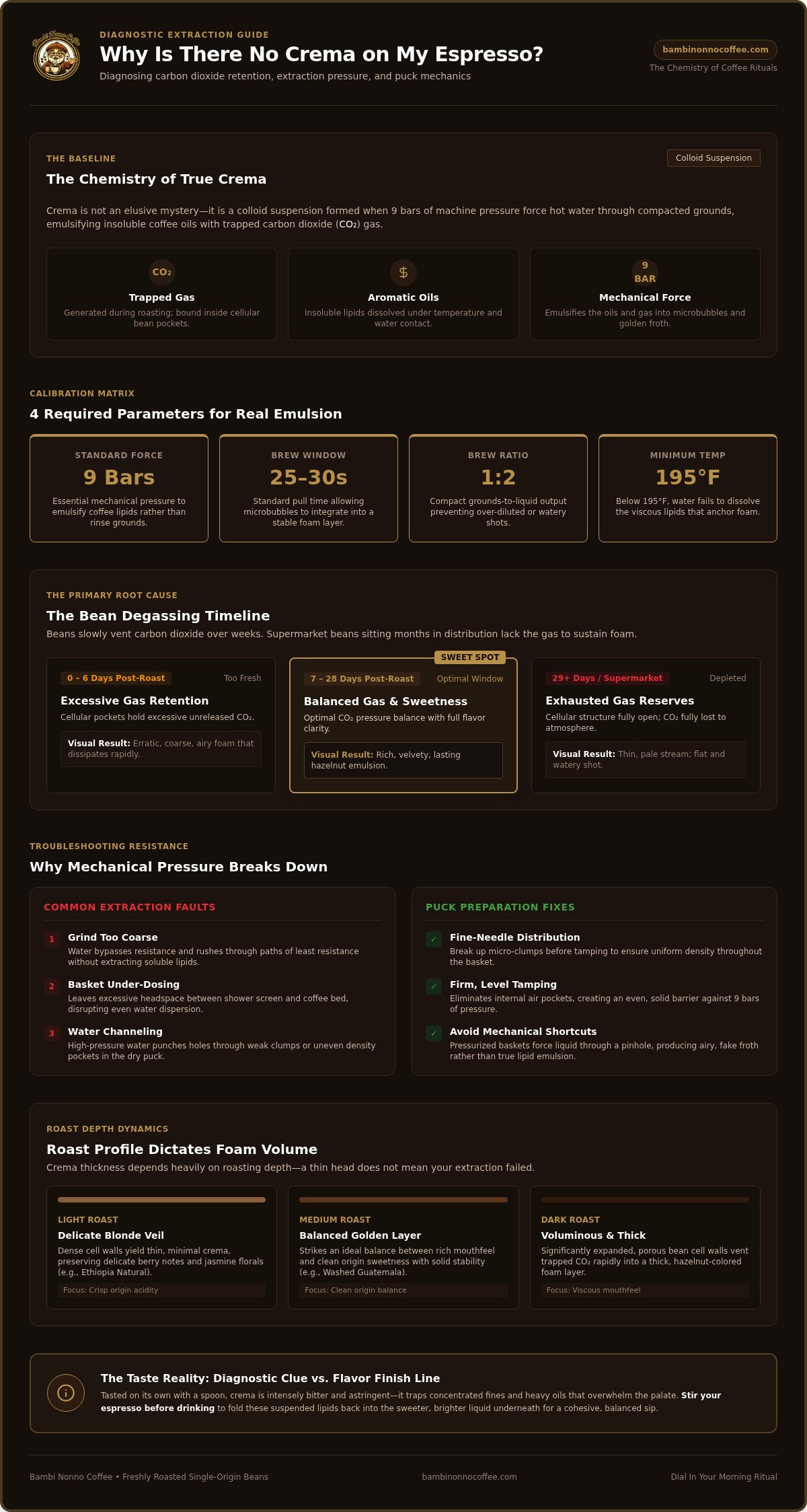
Crema is a colloid suspension of carbon dioxide microbubbles and aromatic coffee oils. When your machine forces hot water through a finely ground, compacted puck at standard 9-bar pressure, it emulsifies insoluble oils into a rich, golden froth. Historically, this foam was so central to the cup that it served as the original term for modern espresso. Without sufficient gas trapped within the cellular structure of the roasted bean, foam simply cannot form, no matter how capable your machine might be.
Understanding this balance transforms how you approach extraction. Pressure does the heavy lifting of emulsification, but the coffee itself provides the raw fuel.
The Degassing Timeline: How Stale Beans Kill Foam
Coffee beans generate carbon dioxide during the roasting process, holding that gas inside tightly bound cellular pockets. Over several weeks, those pockets slowly open up. Supermarket beans that spend months in distribution lose almost all their trapped gases before you bring them home. When you find yourself asking why is there no crema on my espresso, bean age is almost always the prime culprit. Without natural gas retention, pressurized water rushes over the grounds without creating that velvety emulsion.
For the best balance of crema stability and sweetness, brew between 7 and 28 days post-roast. Beans pulled sooner than a week can produce erratic, bubbly foam, while older beans fall completely flat. Choosing freshly roasted single-origin beans ensures your coffee still holds the delicate aromatics and trapped gas needed for a rich, satisfying pour.
Troubleshooting Extraction: Dialing in Grind, Dose, and Prep
When fresh beans still yield a flat shot, mechanical resistance is usually where things break down. Grinding too coarse lets water rush through paths of least resistance. Under-dosing your portafilter basket creates excessive headspace, which ruins water dispersion before pressure ever builds. If your machine brews below 195 degrees Fahrenheit, it also fails to dissolve viscous lipids. Exploring the science of coffee reveals that proper resistance is what allows pressurized water to capture those delicate aromatic compounds.
Pressurized portafilter baskets try to bypass this by forcing liquid through a pinhole to whip up artificial froth. That shortcut produces airy bubbles rather than genuine emulsion. Dialing in true extraction requires adjusting your routine, not relying on mechanical crutches.
Puck Preparation Fixes to Stop Water Channeling
Channeling occurs when high-pressure water punches holes through weak spots in the coffee bed. When you ask why is there no crema on my espresso, erratic puck preparation is frequently the silent culprit. A few quick adjustments restore balance:
- Use a fine-needle distribution tool to break clumps before tamping.
- Apply firm, level tamping pressure to eliminate internal air pockets.
- Target a 1:2 brew ratio pulling in roughly 25 to 30 seconds.
Take your time with each adjustment. If you ever hit a wall dialing in your home grinder, you can always reach out to us for guidance on pairing the right grind with your machine setup.
Beyond the Foam: Evaluating True Taste and Roast Selection
A thick, hazelnut-colored foam looks gorgeous in a clear glass, but looks can deceive. Taste that top layer directly with a spoon; you will quickly find that crema is intensely bitter and astringent. It traps tiny particulate fines and concentrated oils that overwhelm your palate. Stirring your espresso before drinking folds those suspended lipids down into the brighter, sweeter liquid underneath, creating a smooth and cohesive sip.
When you find yourself asking why is there no crema on my espresso, remember that visual presentation is only half the story. The absence of a massive head of foam does not mean your extraction failed to deliver great flavor.
Finding the Right Roast Profile for Your Morning Ritual
Roast depth fundamentally alters how much foam forms in the cup. Darker roasts expand bean cell walls significantly, creating a porous structure that releases carbon dioxide rapidly into voluminous, thick crema. In contrast, dense light roasts yield a much thinner, delicate blonde veil.
Brewing a delicate light roast like an Ethiopia Natural might produce minimal foam, but it showcases vibrant berry notes and jasmine florals that heavy crema would only overpower. If you prefer a richer mouthfeel alongside clean origin sweetness, a washed medium roast like our Guatemala strikes an ideal balance for your morning routine. Trust your palate first, and treat the foam as a helpful visual guide rather than the finish line.
Elevating Your Daily Espresso Ritual
Diagnosing why is there no crema on my espresso rarely comes down to equipment failure. Instead, it's an invitation to slow down and refine your morning routine. A balanced shot relies on beans rested within their sweet spot, thoughtful puck distribution, and steady pressure. Remember that thick foam is simply a helpful extraction clue, not the ultimate measure of flavor.
Every adjustment brings you closer to a cup you love. When you start with beans small-batch roasted to preserve natural carbon dioxide and volatile aromatics, dialing in becomes effortless. We sustainably source our coffees from high-altitude canopies and offer free nationwide shipping on every order. Whenever you want personal tips for your home setup, reach out to our team. Enjoy the quiet process of discovery, one pour at a time.
Frequently Asked Questions
Can I get good crema using pre-ground coffee in an espresso machine?
Pre-ground coffee rarely produces authentic crema because it degasses within minutes of grinding. Vast surface area allows carbon dioxide to escape rapidly, leaving the grounds flat before water touches them. Unless you use a pressurized portafilter basket that mechanically agitates liquid into artificial foam, fresh whole beans ground immediately before brewing remain essential.
Why does my espresso shot pull fast with thin, pale foam?
A fast, pale shot indicates inadequate water resistance in the coffee puck. If you're wondering why is there no crema on my espresso during a ten-second gusher, your grind setting is too coarse or your dose is too small. Fine-tuning the grind creates the hydraulic backpressure required for pressurized water to emulsify natural oils properly.
Does the lack of crema mean my espresso will taste bad?
Not necessarily. While crema signals fresh beans and proper pressure, thick foam itself tastes bitter and harsh. Many delicate, high-altitude coffees taste wonderfully sweet and vibrant with only a minimal layer of blonde foam. Always judge the extraction by its balanced flavor and clarity rather than relying purely on visual thickness.
How do dark and light roast beans compare when producing crema?
Dark roast beans produce thicker, longer-lasting foam because extended heat creates a porous internal structure that traps and releases gas easily. Light roasts remain denser, yielding a delicate, thin layer. If you wonder why is there no crema on my espresso when brewing light roasts, a slender veil of foam is completely normal for that bean density.