

French Roast Coffee: Mastering the Art of the Dark, Smoky Ritual
Is your dark roast a carefully crafted ritual or just a bag of burnt beans hiding behind a fancy name? Many coffee lovers settle for an ashy, bitter cup because they believe intensity has to mean harshness. With the average retail price of ground coffee hitting a record $9.72 per pound in April 2026, you deserve a brew that rewards your investment rather than clogging your grinder with excessive oils.
You've likely felt the frustration of choosing a french roast coffee only to end up with a flavor profile that tastes more like smoke than actual beans. It's a common struggle to distinguish between the smoky depth of a French profile and the even darker, charred edges of an Italian roast. I'm here to help you discover how a well-crafted dark roast can balance bold intensity with a nuanced soul. We'll look at the secrets of small-batch roasting that transform heat into flavors of toasted marshmallow and chocolate. You'll also learn exactly how to brew these dark beans to avoid over-extraction, ensuring every quiet morning moment feels like a discovery rather than a chore.
Key Takeaways
- Identify the "second crack" as the defining moment that releases natural oils and creates that iconic, deep chocolate color.
- Apply the "Lower and Slower" principle to your brewing routine to ensure your cup tastes like toasted marshmallow instead of ash.
- Discover why high-altitude beans are essential for a premium french roast coffee, providing the strength needed to withstand intense heat.
- Distinguish between the deep, smoky soul of a true dark roast and the bitter, over-roasted beans that often clog home grinders.
- Refine your daily ritual by learning how small-batch precision preserves the delicate sweetness hidden within bold, dark profiles.
What Defines French Roast Coffee? Beyond the Second Crack
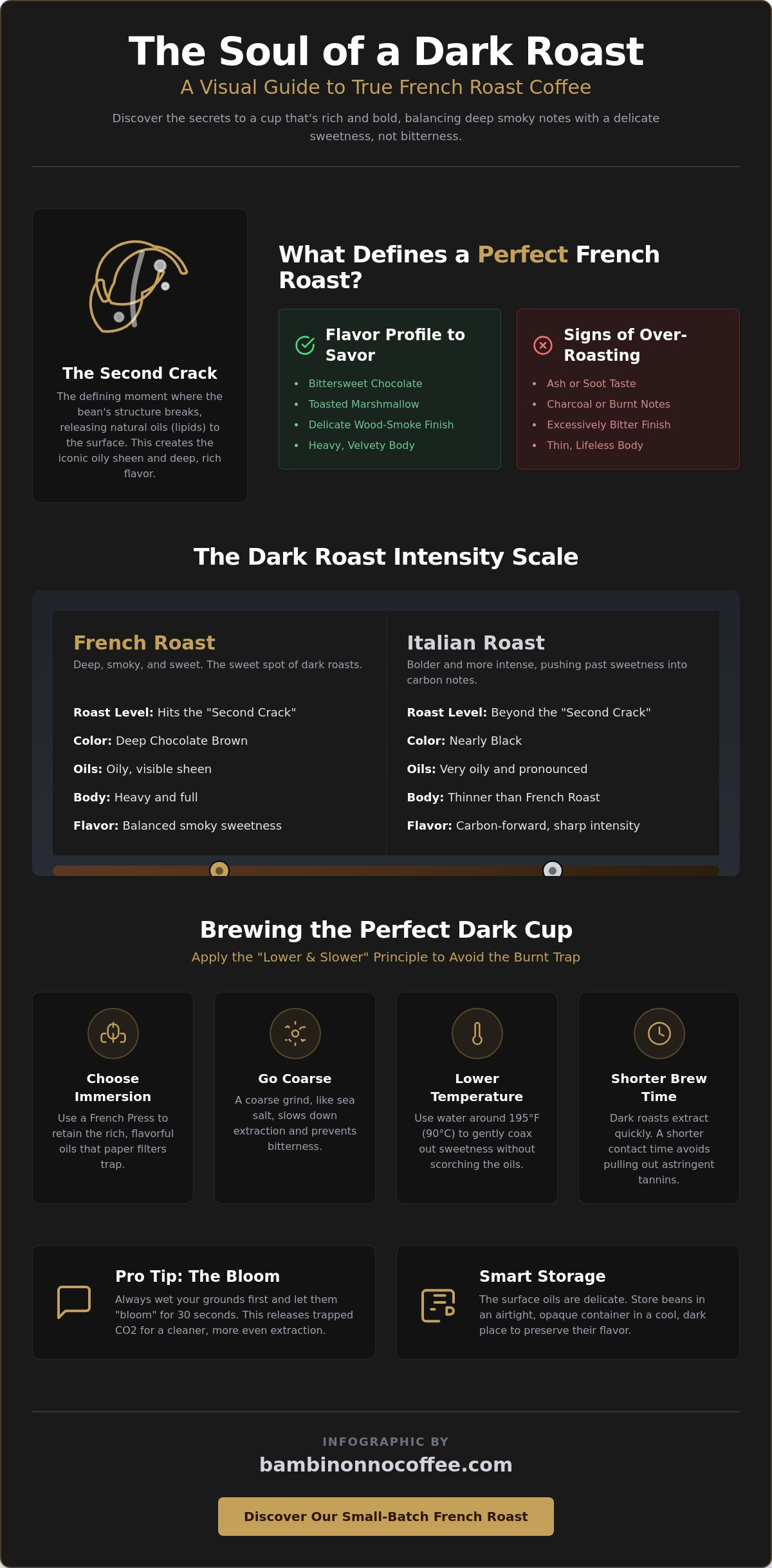
When you pour a bag of french roast coffee into your favorite ceramic jar, the first thing you'll notice is the deep, dark chocolate hue and that unmistakable oily sheen. It's a look that promises a heavy body and a lingering finish. This specific appearance isn't an accident; it's the result of taking the beans right to the edge of their transformation. During the coffee roasting process, the beans reach what we call the second crack. This is a literal sound, like the snapping of small twigs, where the cellular structure of the bean finally gives way under the heat.
To better understand this concept, watch this helpful video:
A true french roast coffee shouldn't taste like a campfire's leftovers. If you're picking up notes of ash or soot, the beans were likely over-roasted or sat in the cooling tray too long. Instead, look for a profile that reminds you of bittersweet chocolate and toasted marshmallows. There's a delicate wood-smoke finish that should feel pleasant and grounding, not harsh. It's about finding that sweet spot where the heat has caramelized the sugars without obliterating the bean's soul. Small-batch roasting is the key here, as it allows for the precision needed to stop the roast before the smoke becomes charcoal.
The Science of the Shine: Why Are the Beans Oily?
As the heat intensifies, internal CO2 pressure builds up inside the bean. This pressure eventually pushes natural lipids, or oils, to the surface. While these oils carry immense flavor and contribute to a velvety mouthfeel, they're also quite delicate. I recommend storing these beans in an airtight, opaque container in a cool spot to keep them fresh. Since they're a bit stickier than lighter roasts, give your grinder a quick brush every few days to prevent any buildup from affecting your future brews.
French Roast vs. Italian Roast: The Intensity Scale
While both are considered dark, they sit at different points on the intensity scale. A French profile retains a hint of the bean's original sweetness and density. If you move even further into the heat, you'll find what's known as an Italian roast coffee. That level is nearly black, with a thinner body and a much more carbon-forward flavor. It's the ultimate choice for those who want maximum intensity, but many find the French roast provides a more balanced, comforting ritual for their daily cup.
Brewing the Perfect Dark Cup: How to Avoid the Burnt Trap
Many people shy away from french roast coffee because they've suffered through a cup that tasted like liquid charcoal. It's a common experience, but it isn't the coffee's fault. The bitterness people often object to usually happens because they're brewing dark beans the same way they'd brew a light roast. Darker beans are more soluble and porous. They've already been through a lot of heat, so they're ready to release their flavors almost instantly. If you treat them too harshly, you'll pull out the flavors you don't want.
To master this, I suggest the "Lower and Slower" principle. Use an immersion method like the French press. This allows the heavy body and those beautiful oils to fully develop without being stripped away by a paper filter. Make sure your grind is coarse, resembling sea salt. Fine particles extract far too quickly, which is the fastest way to fall into the burnt trap.
Temperature and Time: The Secret to Sweetness
Water temperature is your best friend when managing extraction. While general specialty coffee standards might suggest boiling water, I find that french roast coffee is much happier around 195°F. This cooler temperature gently coaxes out the toasted marshmallow and chocolate notes without scorching the surface oils. A shorter contact time helps ensure you don't release the astringent tannins that cause that dry, puckering sensation on your tongue.
The Ritual of the Bloom
There's something deeply grounding about watching the bloom. When you first wet the grounds, they swell and bubble as they release trapped carbon dioxide. This degassing is essential for a clean flavor. It's a quiet moment in the morning that connects us to the life of the roasted coffee beans before they reached your kitchen. If you're ever unsure about how to adjust your technique for a new bag, you can always ask us for a tip to help you get it just right.
The Bambi Nonno Coffee Approach: Small-Batch French Roast
You might have heard the rumor that dark roasts are just a way for roasters to hide old, low-quality beans. In some corners of the industry, that's unfortunately true. At Bambi Nonno Coffee, we see french roast coffee as something entirely different. It's a bridge where the deep, old-world soul of a dark cup meets the rigorous quality of modern specialty standards. We don't use the roast to mask the bean; we use it to celebrate a different, more resilient kind of sweetness.
To achieve this balance, we select high-altitude beans with a dense cellular structure. Beans grown at higher elevations, like our single-origin Guatemala, possess the physical strength to withstand the intense heat of the second crack without collapsing into bitterness. This structural integrity is what allows a well-crafted french roast coffee to maintain its character while developing that heavy, smoky body you love. If you're looking for more variety in your morning ritual, I invite you to explore our collections of blends, where we've carefully balanced different origins to create complex, comforting profiles.
Small-Batch Precision
We roast in small quantities because precision is everything when the heat is high. There's a single second where a bean hits peak caramelization, right before the sweetness turns to carbon. By roasting in small batches, we can pull the beans at that exact moment of perfection. Because we prioritize freshness and US-based shipping, you receive your coffee while those delicate oils are still vibrant and flavorful, never rancid or stale like grocery store alternatives.
A Multicultural Cup
Our obsession with these bold, dark cups didn't happen in a vacuum. It was born from our story of travel and exploration, where we learned that coffee is a universal language of connection. It's the "baby-grandpa" lifestyle: staying curious like a child while honoring the slow, steady traditions of those who came before us. It's a quiet, grounding habit that invites you to slow down. As you brew your next cup, I'll leave you with one thought. Does your coffee simply wake you up, or does it invite you to be truly present in the moment?
Refining Your Daily Dark Roast Ritual
Finding the right balance in your cup is a journey of patience and curiosity. You've seen how the physical markers of oil and color are signs of a specific chemical transformation, not just a label. By using a coarse grind and cooling your water slightly to around 195°F, you can unlock the toasted marshmallow and chocolate flavors that define a truly premium dark roast. It is about moving away from the "burnt" trap and toward a deeper appreciation for the roaster's craft.
Our approach to french roast coffee is rooted in the belief that intensity should never sacrifice quality. We select only responsibly sourced high-altitude beans that can withstand the heat of the second crack while preserving their nuanced soul. Because we focus on small-batch roasting for peak freshness and provide free shipping on all US orders, you can trust that every bag arrives ready for your quiet morning habit. It is a multicultural experience that bridges the gap between old-world traditions and modern specialty standards.
Experience the smoky depth of our small-batch French Roast
Take a deep breath as you pour your next cup tomorrow morning. Let the smoke and sweetness remind you that the most valuable things in life often take just a little more time and attention. Enjoy the process of discovery.
Frequently Asked Questions
Does French roast coffee have more caffeine than light roast?
French roast coffee generally has slightly less caffeine by volume than light roasts. The intense roasting process involves longer exposure to high heat, which causes the beans to lose density and some of their caffeine content. If you measure your coffee by weight rather than by the scoop, the difference becomes almost negligible, but the perceived energy boost is often smoother and less jittery.
Why are French roast beans so oily compared to other roasts?
The oily sheen appears because the intense heat of the roast pushes internal lipids to the surface of the bean. This migration happens during the second crack, when the cellular structure of the coffee becomes more porous under pressure. These oils are where much of the smoky, bittersweet flavor lives, though they do mean you should store your beans in a cool, airtight container to keep them from turning stale.
What is the best way to brew French roast coffee at home?
An immersion method like the French press is the most rewarding way to brew these beans at home. This technique allows the natural oils and heavy body to pass into your cup, which a paper filter might otherwise strip away. Using a coarse grind and water pulled just off the boil at 195°F will help you avoid the common burnt trap and keep the finish sweet and chocolatey.
Can I use French roast beans for espresso?
You can certainly use these dark beans for espresso if you enjoy a very intense shot with a thick crema. The oils on the surface of the bean help create a rich texture that holds up beautifully in lattes or cappuccinos. Just be mindful to brush out your grinder hopper regularly, as the oily surface can cause fine grounds to stick to the burrs more easily than drier, lighter roasts.