

How Much Caffeine is in Coffee? A Guide to Your Daily Ritual
The darkest, boldest roast in your cabinet might actually be the gentlest way to start your morning. Many of us reach for a heavy French Roast thinking it's the ultimate wake-up call, but the reality of how much caffeine in coffee is often the opposite of what our taste buds tell us. While 66% of American adults drink coffee daily, most of us are still guessing at the chemistry bubbling in our favorite mugs. You shouldn't have to choose between a morning spark and afternoon jitters.
It's frustrating when your second cup leads to an unexpected heart flutter instead of a steady flow of focus. We've all been there, standing in the kitchen and wondering if a longer bloom or a finer grind will push us over the edge. This guide will help you master the variables that dictate your energy rhythm, from bean genetics to the science of extraction. You'll learn how to distinguish between caffeine concentration and total intake, giving you the tools to turn your daily ritual into a mindful, personalized experience. We'll explore how roast levels, brewing methods, and even bean origin change the math of your morning.
Key Takeaways
- Discover how terroir and altitude influence a bean's natural defense mechanism, moving your understanding beyond the myth of a standard 95mg cup.
- Learn why caffeine is one of the first compounds to dissolve during extraction and how your brewing method changes the math of how much caffeine in coffee you actually consume.
- Master the role of the bloom to ensure your grounds are properly off-gassed for a more efficient and consistent release of energy.
- Find your perfect daily rhythm by knowing when to switch to a gentler single-origin, like our Guatemala, to extend your ritual without the jitters.
The Alchemy of Caffeine: Why Every Cup Tells a Different Story
Caffeine is more than a morning spark; it is a natural defense mechanism for the coffee plant. In the wild, coffee trees produce this bitter compound to ward off insects and competition from neighboring plants. This means the environment where your beans grew directly dictates their potency. If you have ever wondered about the actual chemistry behind your brew, this comprehensive guide to caffeine explains how this water-soluble alkaloid acts as the heartbeat of your morning ritual.
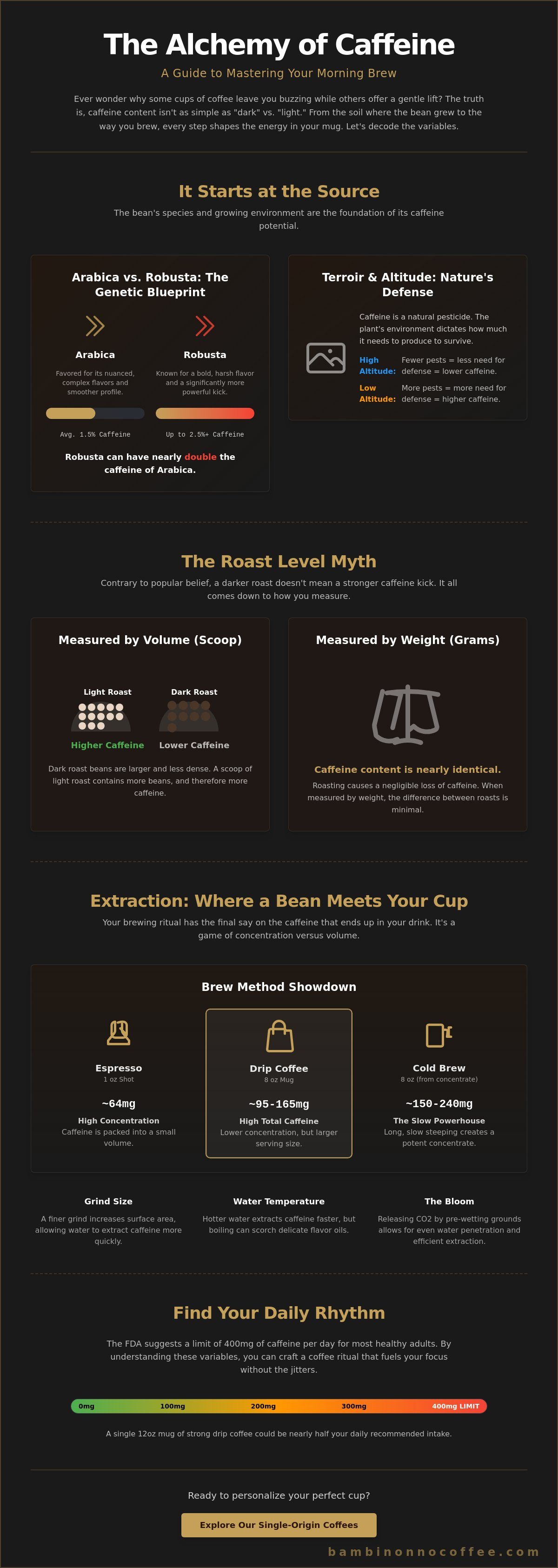
The 95mg per cup figure you see in most health articles is a myth. In reality, the amount is a wide spectrum influenced by terroir and altitude. During our travels shared in Our Story, we discovered that every bean variety brings a unique energy profile. Beans grown at high altitudes often produce less caffeine because they face fewer pests. Lower altitude plants work harder to survive, resulting in a naturally higher kick. Understanding how much caffeine in coffee starts with the soil itself.
To better understand this concept, watch this helpful video:
Arabica vs. Robusta: The Genetic Blueprint
The species of bean you choose is the foundation of your energy levels. Robusta beans typically contain nearly double the caffeine of Arabica. While Robusta is often used for a harsher, more aggressive kick, specialty roasters focus on the Arabica species. Our Single Origin collection prioritizes these nuanced beans to provide a smoother, more sophisticated energy lift that won't leave you feeling crashed by noon.
The Roast Level Myth: Does Darker Mean Stronger?
One of the most persistent myths is that dark, oily beans are more caffeinated. They aren't. Roasting actually causes a negligible loss of caffeine. The real difference is found in how you measure your coffee. Darker roasts are less dense and take up more space. If you measure by volume, a scoop of light roast actually contains more beans and more caffeine. If you measure by weight, the caffeine content is nearly identical. Calculating how much caffeine in coffee depends on these small, mindful details in your kitchen.
From Drip to Espresso: How Your Brewing Ritual Impacts Extraction
Extraction is where the silent potential of the bean finally meets your cup. Caffeine is remarkably water-soluble; it's actually one of the first compounds to dissolve when hot water hits your grounds. This is why even a short brew can pack a punch. To get the most from your beans, you must respect the bloom. Those tiny bubbles of carbon dioxide escaping the surface aren't just for show. They clear the way for water to penetrate the cell structure of the coffee, ensuring an efficient and consistent release of energy. If you skip the bloom, you're essentially locking some of that caffeine away.
Precision in temperature and grind size also dictates the final result. While hotter water extracts caffeine faster, using boiling water can scorch the delicate oils and ruin the flavor you've carefully selected. A finer grind increases the surface area, allowing water to pull more caffeine in less time. Balancing these elements helps you manage how much caffeine in coffee you consume according to FDA guidelines on caffeine, which suggest a 400mg daily limit for most healthy adults.
Espresso vs. Drip Coffee: Volume vs. Concentration
There's a common misunderstanding about concentration. An ounce of espresso certainly has more caffeine than an ounce of drip coffee. However, we rarely drink just one ounce of drip. Your daily Drip Coffee ritual typically involves an 8oz or 12oz mug, which usually delivers a higher total caffeine payload than a single 1oz shot. Drip brewing offers a steadier, more prolonged extraction that matches a slower morning pace.
Cold Brew: The Slow Extraction Powerhouse
Cold brew flips the script on traditional extraction. Without heat to speed things up, this method relies on time. By letting grounds steep for 12 to 24 hours, you create a dense concentrate that determines exactly how much caffeine in coffee ends up in your glass. When comparing Drip Coffee vs. Cold Brew Coffee, the cold method often wins on sheer potency because of that extended contact time. If you find your current ritual isn't hitting the right notes, feel free to reach out and share your brewing journey with us.
Finding Your Daily Rhythm: Managing Your Energy Without Sacrificing Flavor
Coffee isn't just a fuel source; it's a conversation between the bean and your own biology. While we've explored the genetics and the chemistry of the bloom, the final variable is you. Listening to your body's version of extraction is key to a sustainable ritual. While research on the caffeine content in different drinks provides a helpful baseline, your personal tolerance is the only metric that truly matters. When you understand how much caffeine in coffee aligns with your natural pace, you can enjoy that second cup without the shadow of a crash.
Try shifting to a specialty coffee mindset that prioritizes the experience over the effect. Focus on the bright citrus or deep chocolate notes rather than the rush. For those moments when you want the ritual to last longer but your energy is already peaked, choosing a bean like our Guatemala offers a gentler energy profile that respects your afternoon peace. It's about finding a balance that allows the coffee to enhance your day, not dictate it.
Track how you feel 30 minutes after your last sip to find your ideal dose.
Decaf and Half-Caf: The Gentle Alternative
Modern decaffeination has come a long way from the chemical-heavy methods of the past. Processes like Swiss Water preserve the delicate flavors of the bean while removing the stimulant. If you aren't ready to let go of the spark entirely, the Half-Caf hack is a wonderful middle ground. By blending your favorite caffeinated beans with a high-quality decaf, you can maintain your brewing ritual late into the afternoon without sacrificing the complex tasting notes you love.
The Impact of Freshness on the Experience
Freshness plays a surprising role in how you perceive the strength of your coffee. Using freshly roasted coffee beans provides a cleaner, more pleasant buzz because the volatile oils are still intact. These oils carry the aromatics that signal to your brain that a sensory experience is happening, often making a cup feel more satisfying even if the actual caffeine content is lower. Stale beans can lead to a muddy, heavy feeling that many mistake for a caffeine overload.
As you experiment with your next brew, remember that the most important ingredient in your cup isn't the caffeine at all, but the patience you find while waiting for the bloom.
Mastering Your Morning Extraction
Understanding how much caffeine in coffee is the first step toward a more intentional daily ritual. We've seen how the high-altitude forests where we responsibly source our beans impact their natural defense mechanisms, and how your kitchen ritual can either lock in or release that energy. It isn't just about the caffeine rush; it's about the connection between the craft and your own personal pace. When you choose coffee that is small-batch roasted for peak freshness, you're investing in a cleaner experience that prioritizes flavor over a simple stimulant kick.
Whether you're reaching for a bold single-origin or a gentle blend to carry you through the afternoon, your cup should always be a mindful choice. We want to make that journey easier for you, which is why we offer free shipping on all US coffee orders. Finding the right balance takes time and a bit of curiosity, but the reward is a morning that feels exactly like you. Explore our curated Single Origin beans and find your perfect rhythm.
Next time you brew, take a moment to smell the dry grounds before the water hits them; it's the quietest, most revealing part of the ritual.
Common Questions About Your Daily Brew
How much caffeine is in a standard 8oz cup of coffee?
A standard 8oz cup of brewed coffee typically contains between 80 and 100 milligrams of caffeine. This range isn't a fixed rule because factors like bean variety and brewing time play a significant role. If you're using a single-origin Arabica, the count might be on the lower end compared to a blend. It's a helpful baseline to keep in mind when planning your morning rhythm.
Does dark roast coffee have more caffeine than light roast?
Light roast coffee generally has slightly more caffeine when you measure it by the scoop because the beans are denser. During the roasting process, beans lose mass and expand, so a dark roast bean is larger but lighter. If you weigh your coffee with a scale, the difference in how much caffeine in coffee between roast levels is negligible. You should focus on the flavor profile you enjoy most.
Which brewing method extracts the most caffeine?
Cold brew often extracts the most caffeine because of the extended contact time between the water and the grounds. While espresso is more concentrated, the sheer volume of a drip or cold brew cup usually results in a higher total intake. Methods with longer extraction phases allow the water more time to pull the stimulant from the bean's cellular structure, resulting in a more potent payload.
Is espresso higher in caffeine than regular drip coffee?
Espresso has a higher concentration of caffeine per ounce, but a regular drip coffee usually contains more caffeine in total. A standard shot of espresso has about 63 milligrams, while a typical 12oz drip brew can easily exceed 150 milligrams. It's a matter of volume versus intensity. Choosing drip coffee allows for a slower, more meditative ritual without the immediate spike of a concentrated shot.
How many cups of coffee can I safely drink per day?
Most healthy adults can safely consume up to 400 milligrams of caffeine per day, which is roughly three to four 8oz cups of home-brewed coffee. This limit was confirmed in the FDA's August 2024 update. Everyone's metabolism is different, so it's best to listen to your body's signals to determine how much caffeine in coffee is right for you. If you feel restless, you've likely reached your ceiling.
Does adding milk or cream reduce the caffeine content?
Adding milk or cream does not reduce the actual caffeine content in your mug; it only dilutes the concentration. The total amount of caffeine remains exactly the same as when the coffee was first brewed. However, the fats in dairy or plant-based milks might slow down the absorption rate slightly. This can lead to a gentler energy lift rather than a sudden, sharp peak during your morning ritual.