

Why Is My Coffee Bitter? How to Fix Your Brew and Restore the Ritual
You wake up early to enjoy a few moments of stillness, the light just beginning to filter through the window as you prepare your favorite Ethiopia Natural. You've invested in the best beans and the right equipment, yet that first sip reveals a harsh, ashy finish instead of the vibrant notes you expected. It's deeply frustrating to find yourself wondering why is my coffee bitter when you've followed every step with such care. We've all felt that disappointment of wasting a beautiful roast on a brew that feels unbalanced and uninviting.
The good news is that bitterness isn't a flaw in the bean; it's a signal that your brewing ritual is slightly out of sync. You can easily fix this by understanding the science of over-extraction and following the updated 2026 SCA guidelines for water temperature and grind precision. This guide will give you a reliable way to diagnose flavor issues and teach you how to adjust variables like contact time and mineral balance. You'll gain the confidence to transform every morning cup into a delicious, balanced experience that honors the journey from the farm to your kitchen.
Key Takeaways
- Learn the hidden sequence of flavor extraction to understand exactly when your brew crosses the line from sweet to sharp.
- Master simple adjustments to your grind size and temperature to finally answer why is my coffee bitter and restore balance to your cup.
- Discover how the mineral content of your water acts as the silent foundation of flavor and how to optimize it for a cleaner taste.
- Identify the common cleaning mistakes that allow old coffee oils to haunt your morning ritual with unwanted metallic notes.
- Gain the confidence to experiment with your brewing variables, ensuring every bag of specialty beans reaches its full potential.
Understanding Extraction: The Fine Line Between Bold and Bitter
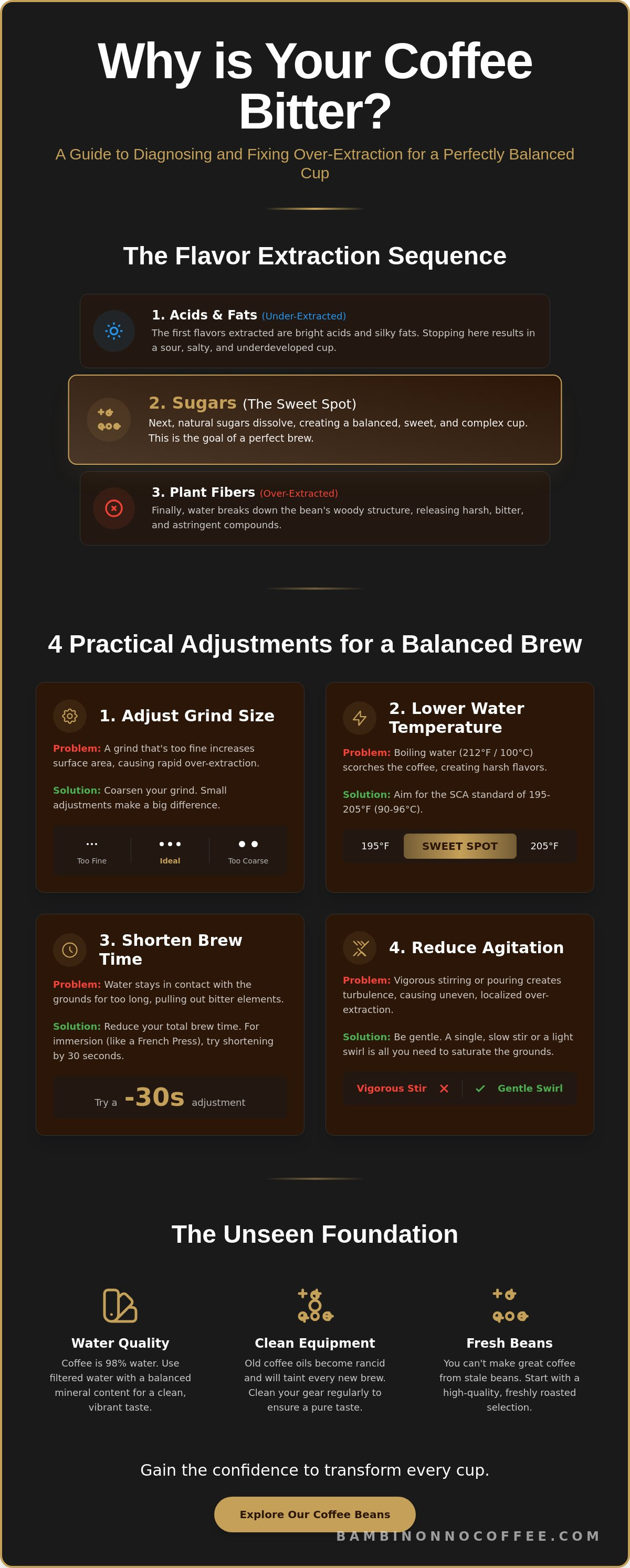
Brewing coffee is a quiet, delicate dance between chemistry and patience. To understand why is my coffee bitter, we first need to look at extraction. This is simply the process of water dissolving the soluble solids from your coffee grounds into your cup. It doesn't happen all at once. There is a beautiful, predictable sequence to the flavors that emerge as water meets the bean. First, the water pulls out the bright acids and silky fats. Next come the sugars that provide balance and sweetness. Finally, if the process continues, the water begins to pull from the heavy plant fibers themselves.
If the water stays in contact with the grounds for too long, the cup becomes over-extracted. This is the exact point where water begins to break down the harsh, astringent organic matter of the bean. Not all bitterness is a mistake, though. In the world of specialty coffee, a touch of bitterness can be sophisticated and intentional. Think of the complex bite of a high-percentage dark chocolate or the refreshing zest of a grapefruit. This is a far cry from the medicinal, ashy taste that ruins a morning ritual.
The Anatomy of a Bitter Cup
When a brew goes wrong, you don't just taste it; you feel it. Over-extraction often creates a physical sensation called astringency. It's that dry, sandpaper feeling on the middle of your tongue that makes you want to reach for a glass of water. It's helpful to distinguish this from roast-level bitterness. A dark roast might have a smoky, charred profile by design. However, if your light roast tastes like burnt rubber, the issue lies in your brewing technique. Understanding this distinction is the first step in diagnosing why is my coffee bitter before you pour your next cup.
Why Your Beans Matter
Sometimes the battle is lost before the water even touches the kettle. Low-grade beans or those that have sat in a cupboard for too long lose their vibrant oils and turn stale. This staleness often manifests as a flat, metallic bitterness that no amount of technique can fix. For example, a well-brewed Ethiopia Natural should greet you with notes of sun-ripened berries and a wine-like acidity. If that same cup tastes like ash, your extraction has likely pushed too far into those woody plant fibers, masking the true character of the origin.
Four Practical Adjustments to Rescue Your Morning Cup
Once you recognize that sharp, unpleasant bite, the next step is finding the right dial to turn. Fixing your brew isn't about complex math. It's about restoring the balance between your water and your beans. If you're still asking yourself why is my coffee bitter, the solution usually lies in slowing down the extraction speed. Each small change you make affects how the water interacts with the chemical compounds that cause bitterness during the heat of the brew.
The Grind Size Solution
Think of your coffee grounds as a landscape. Finer particles have more surface area exposed, which means water can strip away flavors much faster. If your cup tastes harsh, your grind might be too fine. For a more balanced experience, try coarsening your setting. A good visual rule is to move from the texture of fine table salt toward something closer to kosher salt. In drip coffee, this also helps the water flow through the bed at a natural pace. This prevents the water from pooling and over-extracting the bottom layers of your filter.
Managing Brew Time and Temperature
Precision is a form of kindness you show to your beans. Using a simple kitchen timer ensures your ritual remains consistent day after day. If your coffee is an immersion style, like a French press, try shortening the contact time by thirty seconds. Temperature matters just as much. While boiling water at 212°F is common, it can often scorch the delicate oils. Stick to the SCA standard of 195°F to 205°F. Darker roasts are even more sensitive. They've already spent more time in the roaster, so they benefit from water on the cooler end of that spectrum to avoid highlighting carbonized flavors. If you want to explore more ways to refine your morning routine, you can browse our latest brewing stories for inspiration.
Finally, watch your agitation. It's tempting to stir vigorously during the bloom, but too much movement can cause localized over-extraction. A gentle swirl or a single, careful stir is usually enough. This ensures all grounds are saturated without forcing the bitter plant fibers into your cup.
The Unseen Elements: Water Quality and a Clean Slate
Sometimes, the secret to a perfect cup isn't found in the beans or the brewer, but in the environment surrounding them. If you've refined your technique and still find yourself asking why is my coffee bitter, it's time to look at the invisible factors. Your water and the state of your equipment are the silent partners in your morning ritual. When they aren't cared for, they can easily overpower the most delicate flavors you're trying to highlight.
Is Your Water Working Against You?
Water accounts for nearly 98 percent of your final brew. It acts as the solvent that carries the soul of the bean into your cup. If your tap water is "hard," it's packed with minerals like calcium and magnesium. While these minerals are essential for pulling out sweetness, too many of them can lead to a harsh, chalky extraction. Conversely, water that is too soft or distilled lacks the "grip" needed to extract flavor properly, often resulting in an imbalanced cup. Using a simple water filter provides a clean canvas, allowing the natural character of the origin to shine through without mineral interference.
The Importance of a Clean Ritual
Coffee is an organic product rich in oils. These oils are what give your brew its body and aroma, but they're also prone to oxidation. When left on a French press mesh, a glass carafe, or inside your grinder, they go rancid. This creates a sharp, metallic bitterness that can haunt even the highest quality roasted coffee beans. To keep your ritual pure, try these simple maintenance habits:
- Rinse your brewer with hot water immediately after every use.
- Deep clean glass and stainless steel parts weekly with fragrance-free soap.
- Brush out your grinder burrs once a month to remove stale buildup.
At Bambi Nonno Coffee, we believe coffee is a bridge between cultures and a celebration of the quiet moments in between. It's a habit that rewards a curiosity mindset. Instead of changing everything at once, try adjusting just one variable tomorrow morning. Perhaps it's a fresh filter for your water or a deeper scrub of your carafe. This patient, attentive approach is how we learn to listen to the coffee. When you treat the process with respect, the bean rewards you with a story of its own, free from the shadow of bitterness.
Restoring the Harmony of Your Morning Ritual
Finding the perfect balance in your cup is a patient act of love. You've learned that bitterness is often just a sign that your extraction is out of sync. By coarsening your grind and minding your water quality, you've turned a confusing problem into a simple ritual of adjustment. These quiet changes at the kitchen counter are what transform a routine into a moment of true connection.
We take that same care with every bean we select. Our coffee is responsibly sourced from high-altitude forests and small-batch roasted to ensure peak freshness reaches your door. We want your mornings to be effortless, so we provide free shipping on all US coffee orders. If you're still searching for that elusive, sweet spot and wondering why is my coffee bitter, don't be discouraged. Every cup is an opportunity to learn something new about the craft.
Explore our small-batch blends and find your perfect balance.
Try to change only one thing at a time. The most rewarding discoveries usually happen when we slow down and pay attention to the smallest details.
Frequently Asked Questions
Is bitter coffee stronger than sour coffee?
Bitter coffee isn't necessarily stronger than sour coffee; it's simply more extracted. Strength refers to the concentration of coffee solids in your water, while bitterness is a flavor profile that emerges when you've pulled too much from the grounds. A sour cup is under-extracted, often tasting thin and sharp. You can have a strong cup that is perfectly balanced if the ratio and extraction time are in harmony.
Can I fix a cup of coffee that is already bitter?
You can often rescue a cup that's already brewed by adding a very small pinch of salt. Sodium ions interfere with your tongue's ability to perceive the chemical compounds that cause bitterness. It won't change the physical extraction of the brew, but it can make the flavor much more palatable. This is a handy trick when you're still learning why is my coffee bitter and want to avoid wasting a morning brew.
Does the roast level affect how bitter the coffee is?
Roast level plays a significant role in the baseline bitterness of your beans. Darker roasts, such as a French Roast, undergo more intense heat, which breaks down plant fibers and creates carbonized flavors. These roasts are naturally more bitter than light or medium roasts. However, even a light roast can taste unpleasant if you over-extract it. The goal is to find a ritual that honors the specific roast you've chosen.
What happens if I use boiling water on my coffee grounds?
Using boiling water directly on your grounds often results in a harsh, burnt flavor profile. At 212°F, the water is too aggressive and extracts the bitter plant fibers before the sweeter notes have a chance to balance the cup. This is a common reason why is my coffee bitter for many home brewers. Letting your kettle sit for about a minute after boiling brings it into the ideal range of 195°F to 205°F.